
Agile has been around since 2001 and one could argue it's become more mainstream over the last 5 or so years. At Agile 2015, Declan Whelan and I ran a simulation that helped participants see a pre-Agile organization transform to a post-Agile organization. We'll be posting details on this game soon. 
- annual planning and budget process
- HR performance reviews (namely how individual performance reviews erodes the team mentality needed for Agile to work)
- mass firings/hirings (for organizations that do this to meet quarterly financial objectives)
- re-orgs (for organizations that move people between departments every year to 'shake things up'
- for whatever audits (internal, SOX or other) happen throughout the year
- CAPeX vs OPeX optimization (freezing budgets, flooding the org with training, redirecting funds to game the system etc)
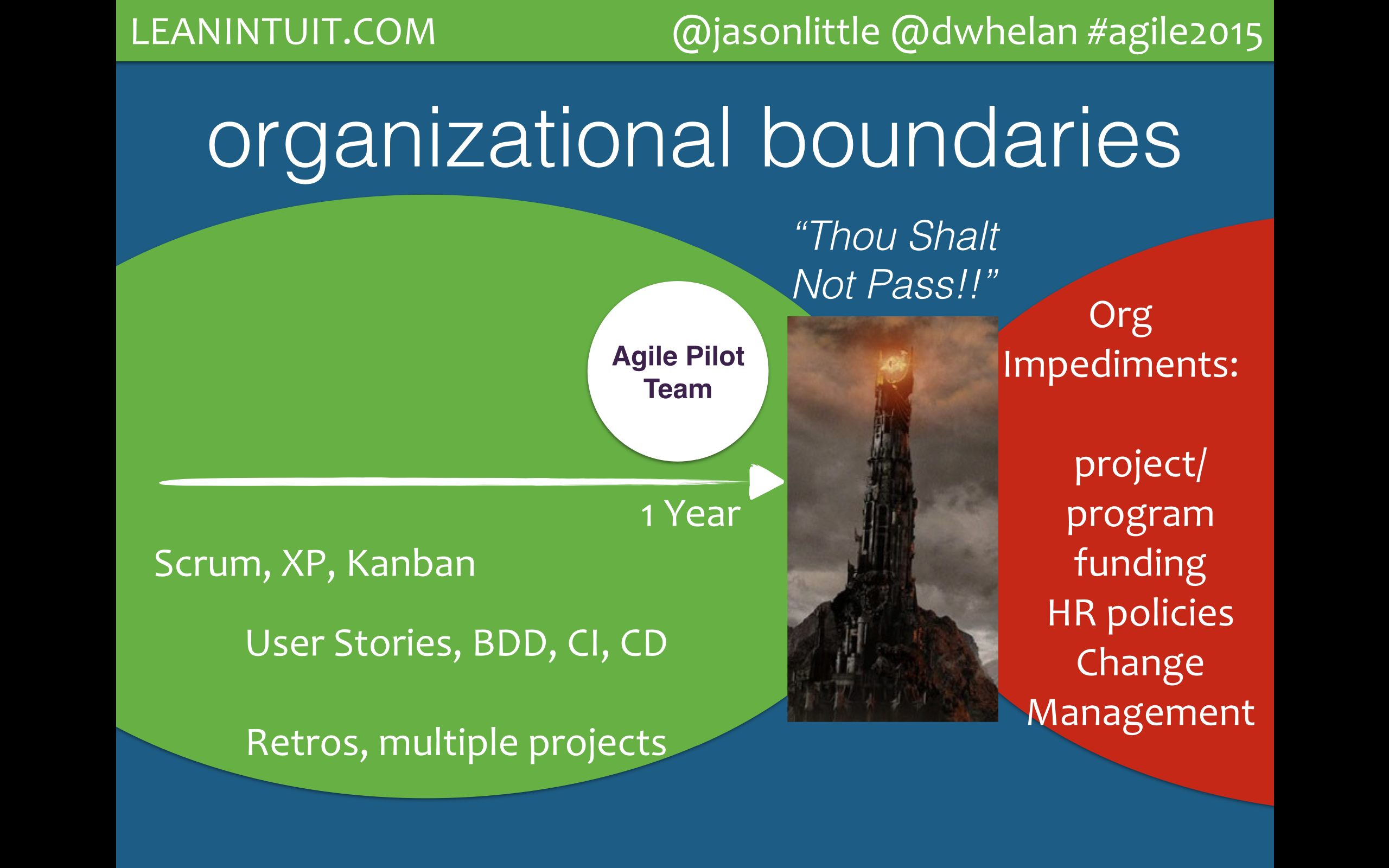
These are the ones I've encountered, but the point is, its these organizational impediments that get in the way. Agile isn't the problem. Correlation isn't necessarily causation, so you may come to your own conclusion about the reasons organizations have been struggling with Agile. We analyzed 9 years of Version One's State of Agile Development survey and the reasons why organizations are struggling with Agile remain consistent year after year. 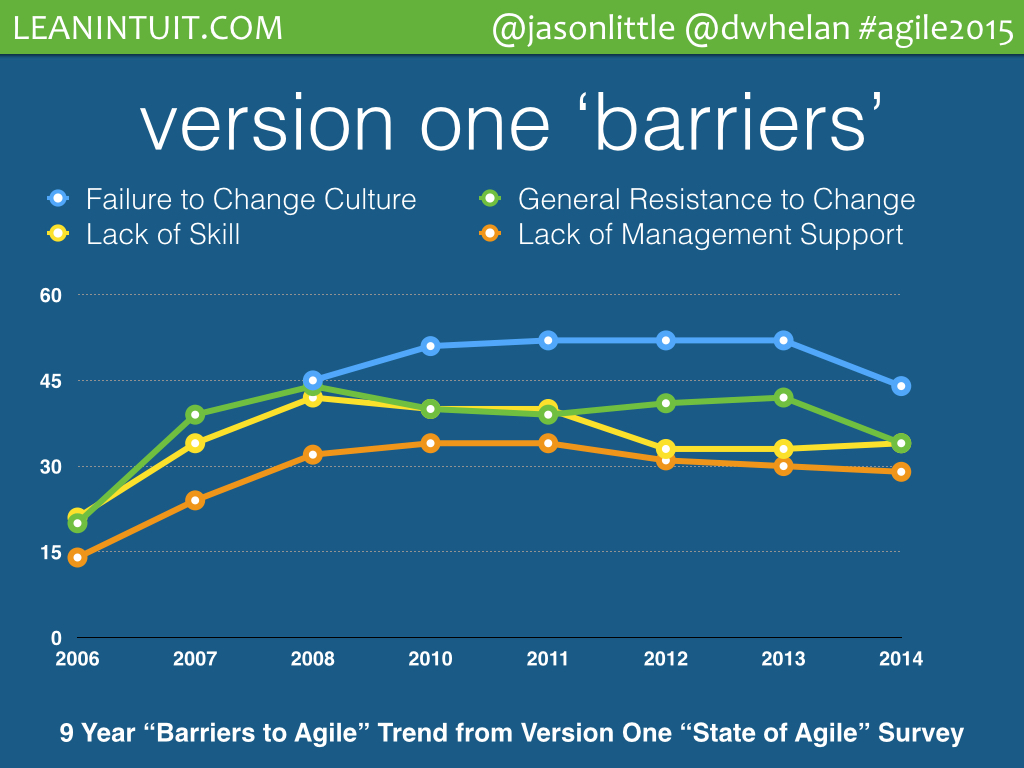
[button link="http://leanintuit.com/downloads/agile2015/" type="big" newwindow="yes"] Get the Full Report[/button]
Both of these reasons are similar to saying "I have no idea what happened, but it's someone else's fault, not mine." The focus of our talk was to align your organizational structure around your organization's purpose and don't worry too much about all the 'be Agile' and 'Agile mindset' stuff. My personal belief is that an Agile mindset is better but some people get it, and others simply don't...and never will. If we all shared the same grey matter up top, we could all adopt the Agile mindset, but we don't. You can view our slides below and also see a video interview we recorded with SolutionsIQ:
Agile 2015 - Navigating Organizational Change from Jason Little
Start the conversation