Patterns
The Five Universals of Change
The Five Universals of Change focus on five patterns that guide effective change: aligning people around a common purpose, fostering meaningful dialogue, co-creating solutions, encouraging experimentation, and responding to change constructively. These patterns help create a more inclusive and adaptive change process.
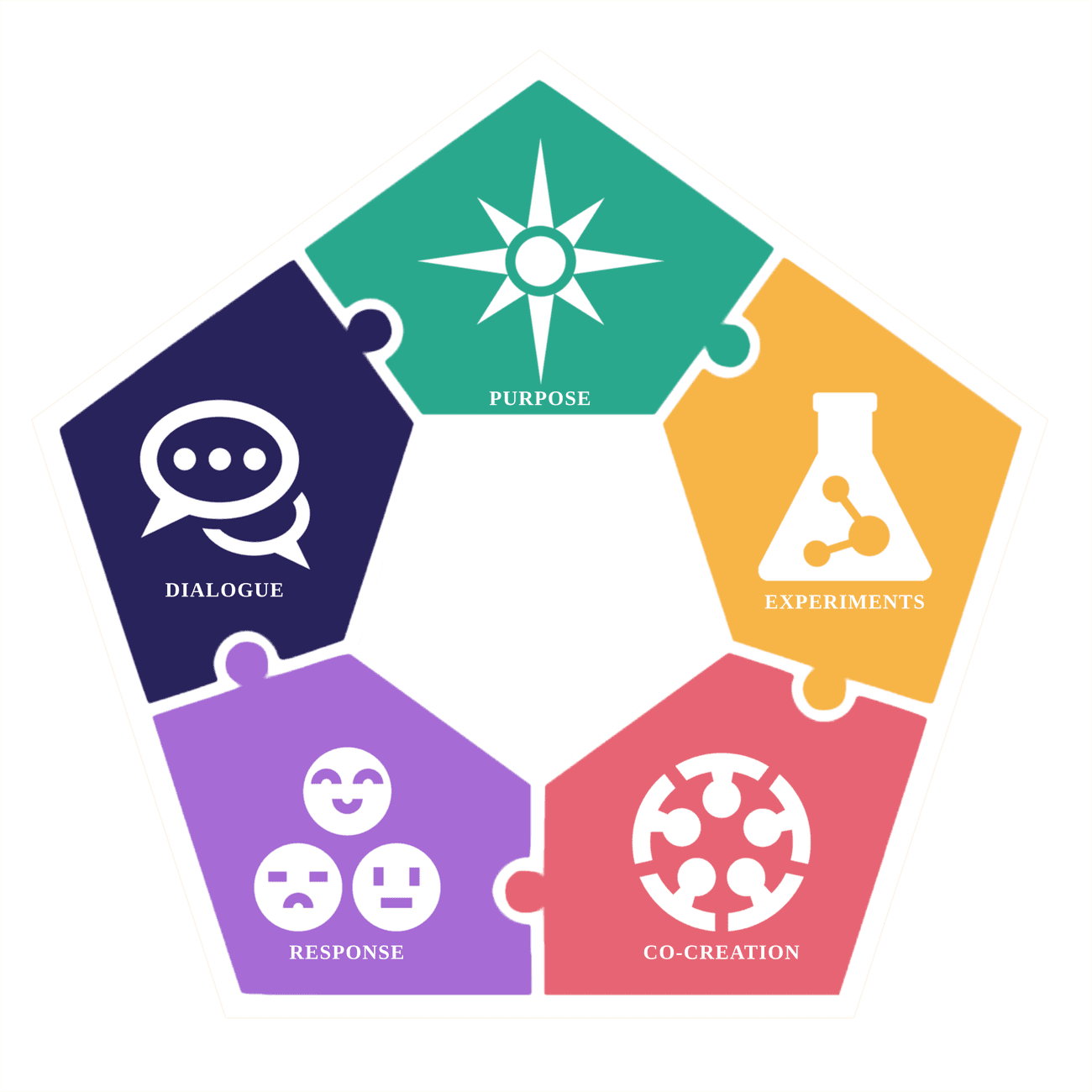

Where they sit in the operating system
The Five Universals of Change are simple rules for navigating complexity. They surround the Lean Change Engine and guide how you work with change — what you pay attention to, how you act, and how you adapt as you learn.
Rather than prescribing what to do, they act as enabling constraints. They provide enough structure to guide behaviour without requiring you to analyze every possibility or follow a predetermined path. They constrain some actions while leaving many others possible.
This gives you the freedom to respond to the situation in front of you while staying within a small set of patterns that help you navigate change effectively.
And they weren't created in a boardroom.
Over more than a decade, thousands of practitioners have brought their toughest change challenges into Lean Change courses — sharing what they tried, what worked, and what didn't. As those experiences were collected and analyzed, the same patterns kept appearing across industries, geographies, and different kinds of change.
Strip away what was unique to each situation, and five universals remained.
How the Five Universals work
All five together
The Universals are connected, not separate. Purpose gives dialogue something to orient around. Dialogue surfaces the right problems for co-creation. Co-creation generates the hypotheses worth experimenting on. Experiments produce the responses worth learning from.
Each universal has a set of prompts — specific directions for putting it into practice. They're not instructions: read each one against the change you're in, and turn what it surfaces into an action, an intervention, or an experiment worth running.
Purpose
People move when they understand why a change matters to them.
Purpose over creating urgency for change
Urgency is a matter of perspective. What is urgent to the organization — staying relevant, cutting costs — may mean nothing to a team member trying to figure out how their daily work will change.
Organizations that could align people around a shared purpose generated more meaningful and durable change than those that relied on instilling a sense of crisis. Purpose gives people a reason to move. Urgency gives them a reason to be afraid. Fear produces compliance. Purpose produces commitment.
In practice
Before designing the change, ask: what does this mean to the people on the ground? What purpose can they connect to — beyond the organizational rationale? Run a session to find out before you start communicating.

The 7 prompts
Read each one against the change you're in.
Leadership Perspective
We understand and can clearly articulate why leadership believes this change is important.
Organizational Perspective
We understand and can clearly articulate why this change is important to the organization.
People Perspective
We understand and can clearly articulate what’s in it for us and/or our people.
Reinforcing
When we feel uncertain about where the change is going, we revisit the purpose behind it to remind ourselves of the ‘why’.
Storytelling
We make the most of storytelling to rally people around our cause and purpose for change.
Congruence
Our purpose for change is compelling and we don’t sugar coat or spin our messaging.
Passion
We encourage and support those who are passionate about the change even if we don’t always agree with them.
Dialogue
Change happens in conversation, not in announcements.
Dialogue over broadcast-style communications
It’s never a bad idea to share information. But broadcasting — newsletters, scripted town halls, change intranet sites — is communication built for the sender, not the receiver.
Organizations that used tools that provoke dialogue — Lean Coffees, unscripted conversations, open retrospectives — moved through change with more confidence despite uncertainty. Dialogue surfaces what people actually think. Broadcast tells you what you want people to think. Only one of those is useful information.
In practice
Replace at least one scheduled broadcast — a town hall, an email update, a launch event — with a Lean Coffee or a facilitated conversation. Put what you learn ahead of what you transmit.
The 7 prompts
Read each one against the change you're in.
Conversations
We always encourage open, honest, and sometimes hard questions from those affected by the change.
Personal Safety
We make it safe for people opposed to the change to give their honest feedback.
Face to Face
We take on extra effort to have face-to-face dialogue wherever possible.
Honesty
We don’t ‘spin’ messages through our existing communication channels about the change.
Bridge Building
We help people who fundamentally disagree about the change see each other’s perspectives.
Communication
We always focus on meaningful dialogue versus broadcasting information to people.
Perspective
We help people understand that everyone expresses themselves differently and to ‘get curious’ instead of ‘furious’.
Co-Creation
Buy-in is what you ask for after deciding; co-creation happens before.
Co-Creation over getting people to “buy in”
Buy-in assumes the change was designed correctly and the challenge is getting people to accept it. Co-creation assumes the people affected know things the change team doesn’t — and that involving them in the design produces a better outcome.
The difference isn’t philosophical; it’s practical. When people help design what they’re being asked to adopt, resistance drops, ownership grows, and the change reflects the real complexity of the situation rather than the assumptions of the people who designed it in isolation.
In practice
Bring the people affected into the design of the change — not as reviewers of a finished plan, but as contributors to an unfinished one. A Change Canvas reviewed with teams before launch is co-creation. A presentation of a completed plan is not.
The 7 prompts
Read each one against the change you're in.
Collaboration
We work through our differences about the change without coercing people.
Uncertainty
When we’re uncertain, we always invoke dialogue with those affected by the change versus making a ‘better plan’.
Approach to Change
We always balance a push-and-pull approach to change.
Viral Change
We use social structures and paths of influence to virally spread change organically versus enforcing compliance through hierarchy.
Support
We give people ‘get out of jail free’ cards by making it safe for them to be involved in the change.
Courage
We lead by example and do the right thing even when it’s not a popular thing to do.
Genuine
When we say we value ‘co-creation’ we mean it, and we don’t just say we mean it for the sake of optics.
Experiments
A plan assumes you already know what will work. An experiment assumes you don’t.
Experiments over executing tasks in “the plan”
Some change goals are known and repeatable — execute the plan. But most organizational change involves real uncertainty: we don’t know exactly what will work, how people will respond, or what things will look like in six months.
Treating change as an experiment — forming a hypothesis, running a small test, learning from the result, adjusting — isn’t a sign of poor planning. It’s the right response to uncertainty. Organizations where it was safe to try things moved faster and adapted better than those that defined success as sticking to the plan.
In practice
Pick one assumption about the change and design a small test to check it. Decide what you expect to happen, what you’ll watch for, and what you’ll do with the result. Then run it.
The 7 prompts
Read each one against the change you're in.
Visualization
We visualize our change work using big visible walls to be transparent about what we’re working on.
Celebrate Success
We celebrate the good things, no matter how small they are.
Accept Failure
We accept failure, take learnings, wipe the slate clean, and move on without blame.
Diagnostics
We have the right leading indicators that help shape our future experiments and direction.
Measurements
The people affected by the change have created their own measurements that align to organizational objectives.
Facilitate
We design experiments to reduce barriers preventing people from adopting the change.
Feedback-Driven
We use feedback from experiments as input into how we adjust our change plans.
Response
Resistance is information — the useful question is what, not who.
Response over blaming people for resisting
Resistance isn’t an obstacle. It’s information. When people push back on a change, they’re responding to something real — a concern about their role, a gap between the stated purpose and what they see, or a difference between the change team’s understanding and their own experience.
Organizations that treated resistance as feedback used it to redesign their approach. Those that treated it as a people problem spent their energy overcoming it instead of learning from it — and usually got surface-level compliance instead of real change.
In practice
When someone pushes back, ask “what is this telling us?” before asking “how do we address this?” Get curious before you get defensive. The concern usually contains something about the change that the change team doesn’t know.
The 6 prompts
Read each one against the change you're in.
Emotions
When faced with ‘resistance’ we listen with curiosity versus trying to convince ‘resisters’ they’re wrong.
Readiness
Teams and people pull changes when they’re ready.
Empathy
When we don’t see change happening, we seek to understand why from the people affected.
Pace of Change
We wait for change to take its natural course versus pushing more when people aren’t ready.
Sense Making
When people don’t agree, we facilitate powerful conversations to help people make sense of their context to agree on the best course of action.
Stress
During stressful change, we take time to slow down and sometimes vent in order to re-focus.
How the Five Universals help you act differently
Start
You
Your beliefs and experiences shape how you act.
“Experiments won’t work around here.”
Check
The Five Universals
Encourage you to look at change through a different lens.
“Maybe we should try experimenting more.”
Look
Prompts
Point you toward acting in line with the Five Universals.
“I’m going to try making the change work visible to increase alignment.”
Try
Interventions
Turn what the prompt surfaces into something you could do.
Big Visible Change Wall
…and the intervention you pick becomes your next experiment in the Lean Change Engine.
Real-world case study
A merger of equals, and eighteen months of waiting
A multinational preparing for Legal Day One while nothing could yet be implemented
The challenge
A multinational was preparing for a merger of equals, with a long wait for regulatory approval ahead. The team had to plan for Legal Day One while nothing could yet be implemented — and keep employees informed and engaged so the silence didn’t fill with rumour.
What happened
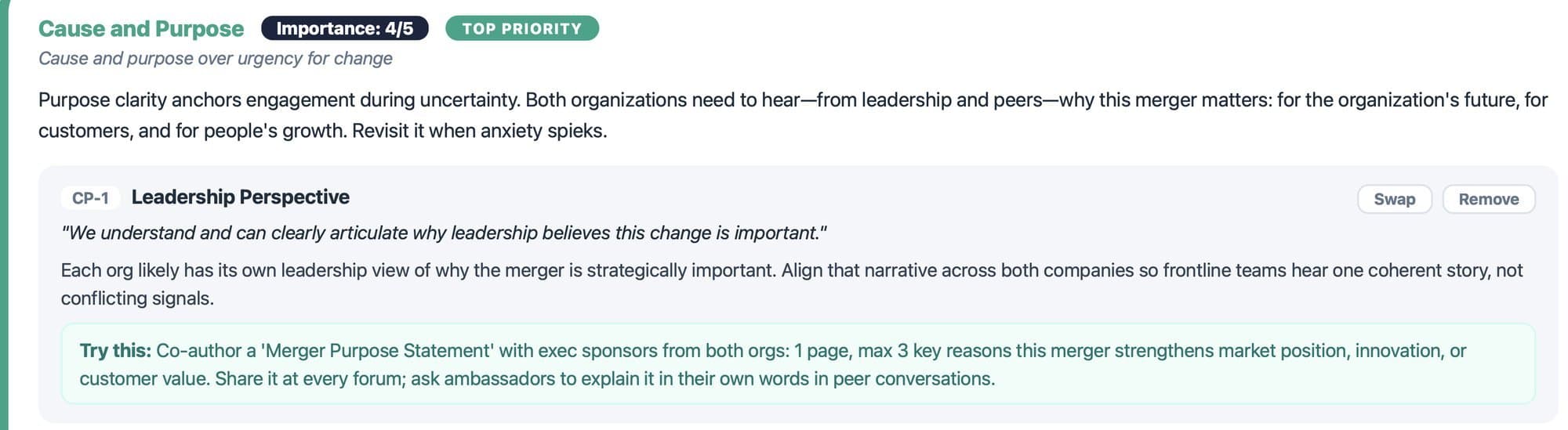
The team rated each Universal for this stage of the merger. Co-Creation, Meaningful Dialogue and Cause & Purpose came out on top, and their prompts led to three interventions: regular pulse checks and story collection, a confidential feedback board employees could vote on, and a weekly dialogue campaign led by the Integration Lead.
Read the full case studyHide the full case study
The challenge
A multinational company was preparing for a merger of equals with another organization. While awaiting regulatory approval, the integration team faced a unique challenge.
On one hand, the team needed to prepare for Legal Day One — developing plans, communications, and operating models for changes that could not yet be implemented. On the other hand, employees needed to remain informed and engaged throughout an extended period of uncertainty. Without regular communication and meaningful involvement, the absence of information risked creating rumours, anxiety, and speculation.
The challenge was not simply to manage communications. It was to design a change approach that balanced readiness with engagement while operating under significant uncertainty.

Applying the Five Universals
Rather than treating the Five Universals of Change as a checklist, the change team used them as patterns to determine where leadership attention would have the greatest impact at this stage of the merger.
Together, the team reviewed each of the Five Universals and rated them on a scale of 1 to 5 based on their importance in the current context. This created a shared understanding of where effort should be focused, while recognizing that these priorities would likely evolve as the integration progressed.
The highest priorities were:
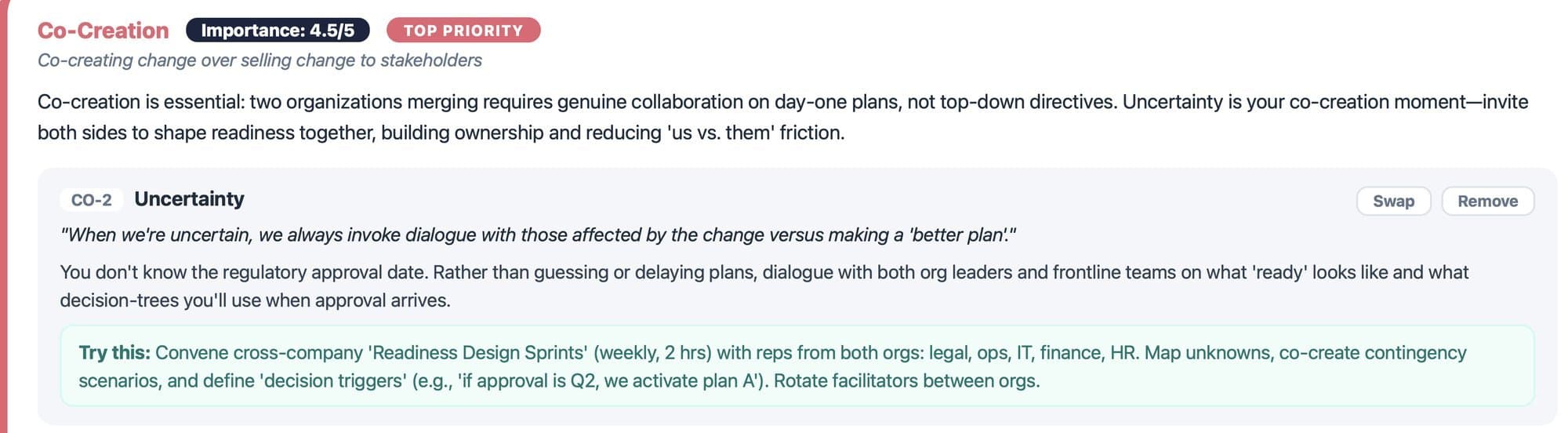
- Co-Creation over Selling Change — with many decisions still to be made, the focus was on planning with colleagues from both organizations while continuously seeking feedback from employees.
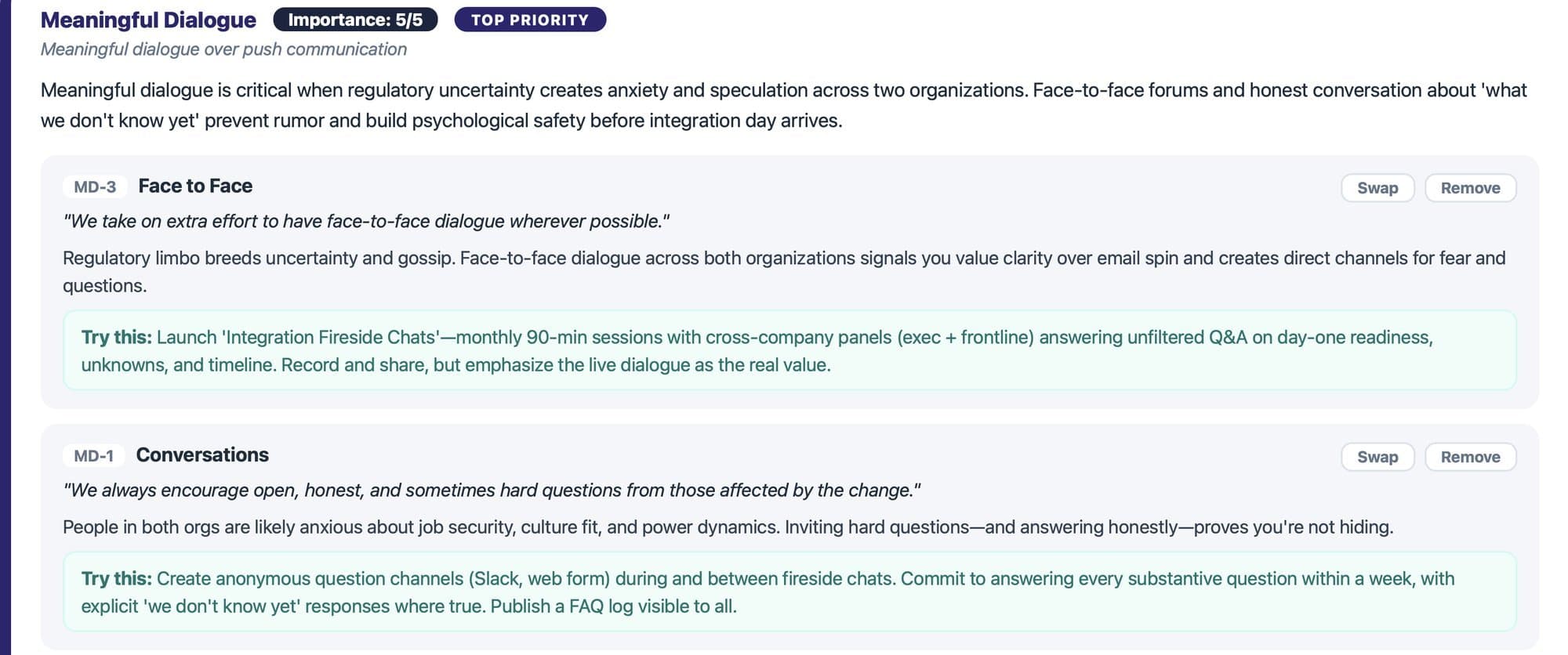
- Meaningful Dialogue — during periods of uncertainty, information vacuums are quickly filled with rumours and speculation. The team prioritized frequent, honest, two-way conversations to keep people informed and surface emerging concerns.
- Cause and Purpose — leaders consistently reinforced why the merger was taking place, the outcomes it was intended to achieve, and how employees contributed to that future.
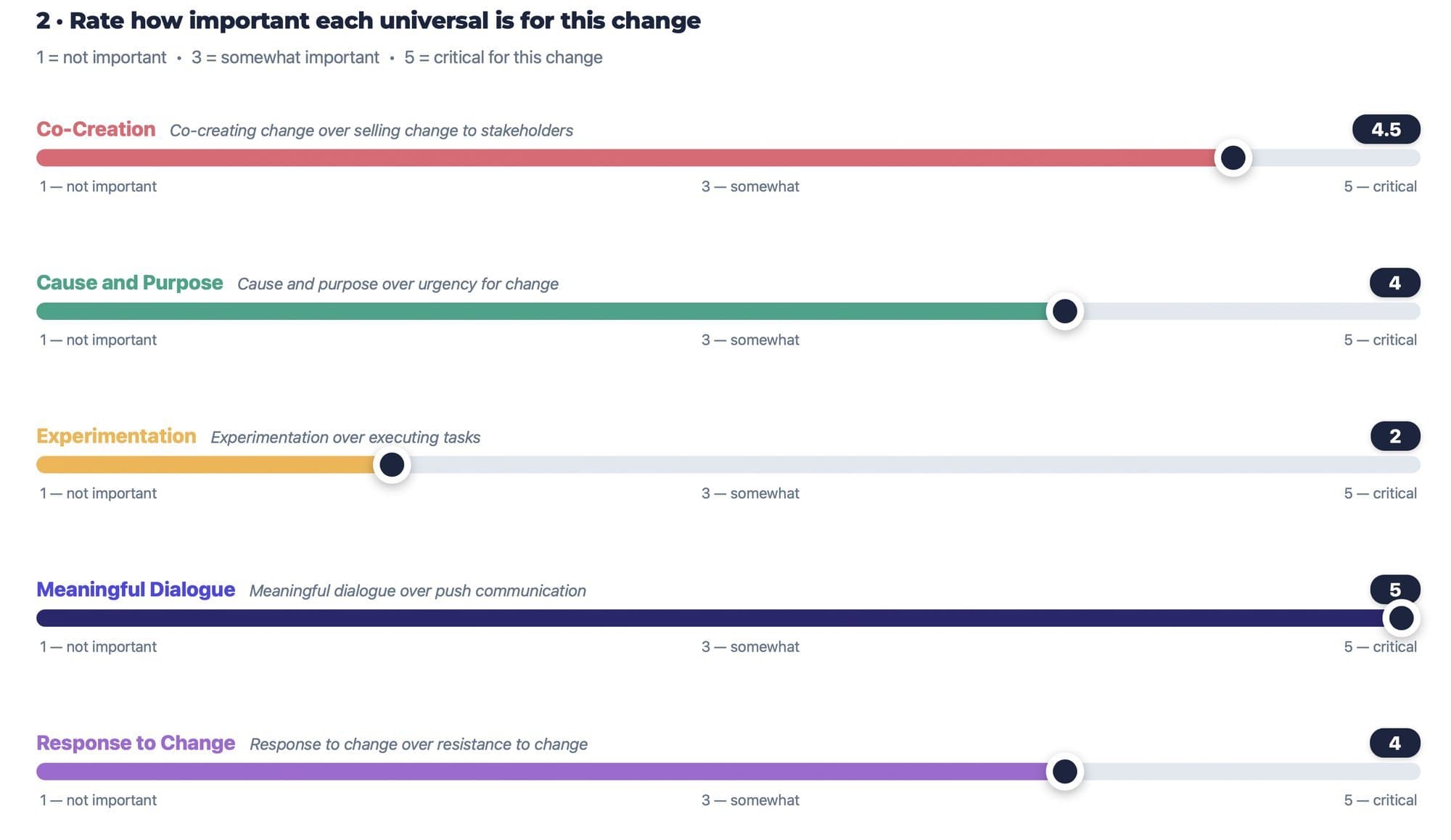
The team also remained mindful of Response to Change, ensuring that communications acknowledged uncertainty, respected people’s reactions, and created opportunities for questions and support.
From patterns to practice
The Five Universals did not prescribe specific actions. Instead, they helped the change team determine where leadership attention was needed most and guided the design of the engagement strategy.
Setting the priorities was only half the work. For each universal that scored highest, the team went to its prompts and picked the ones that mattered most for this change. The prompts are where the interventions came from — not the scores.
Based on these priorities, the team recommended several key interventions.
Regular pulse checks and narrative collection
The team introduced regular pulse checks and collected employee narratives to understand how people were experiencing the merger. Rather than relying solely on survey scores, they listened to the stories employees were telling about the integration, allowing leadership to identify emerging concerns and adjust their approach.
Confidential merger feedback board
A confidential online feedback board allowed employees to anonymously ask questions, raise concerns, and suggest ideas. Colleagues could vote on the issues that mattered most, helping leadership prioritize topics for town halls and leadership communications.
A dialogue-driven communication campaign
Rather than relying on occasional project updates, the team established a consistent dialogue campaign. Each week, the Integration Lead published a blog summarizing progress, current activities, and what employees could expect next. Even during quieter periods, the updates continued, creating a predictable rhythm of communication that reduced uncertainty. Leaders also met regularly with small groups across the organization, creating opportunities for open discussion and questions. Rather than focusing communication outward on the other organization, these conversations focused inward — helping employees make sense of their own experience of the merger.
Key takeaway
The Five Universals of Change are not a checklist of activities or a prescriptive methodology. They provide a different lens through which to view organizational change.
By highlighting where an approach may be weak against the universal patterns that underpin successful change, they help change leaders identify where their attention is needed most. From there, teams can design interventions that fit their unique context.
The Five Universals didn’t tell the team to create a weekly leadership blog, establish a confidential feedback board, or run pulse checks. Instead, they pointed the team toward the underlying needs — greater dialogue, stronger co-creation, and a clearer sense of purpose. Those insights then informed the selection of practical actions that were appropriate for the organization and its situation.
Training & certification
Learn to run the operating system
Learn how to apply the Lean Change Operating System to real-world change initiatives by enrolling in one of our training programs. More than a certification course, it's an immersive learning experience designed to transform how you think about, design, and lead change in complex environments.
Whether you're new to Lean Change or looking to become a certified practitioner, you'll gain practical tools, proven practices, and the confidence to continuously sense, learn, and adapt as change unfolds.