Would you sign it?
Imagine you've just led a change that went really well. People are using the new system, adoption is strong, and the benefits are showing up.
Then another organization calls. They saw your work and they're rolling out the same system. They want you as their change lead, and the contract is generous.
You're about to sign when you read the fine print. You have to guarantee the same results you got last time. If you don't, they claw back half of what they paid you.
Would you sign?
I've asked this question in a lot of rooms, and almost nobody says yes. When I ask why, the answers come quickly. Different people. Different culture. Different leaders. Different history.
Here's the interesting part. You know who would sign? The people who build the system. They can promise the result because their work can be planned. They know what has to be built, in what order, and what done looks like.
Organizational change management doesn't work that way. Change managers already know this in their gut. Most just haven't had the language for explaining why.
This article will offer three big ideas for why no change manager would sign that contract.
Big idea 1: Organizational change is complex, not complicated
It only takes one word to explain why you wouldn't sign the contract. Complexity.
The trouble is that complexity, and how it differs from complicated, isn't well understood in most of business, and that includes change management.
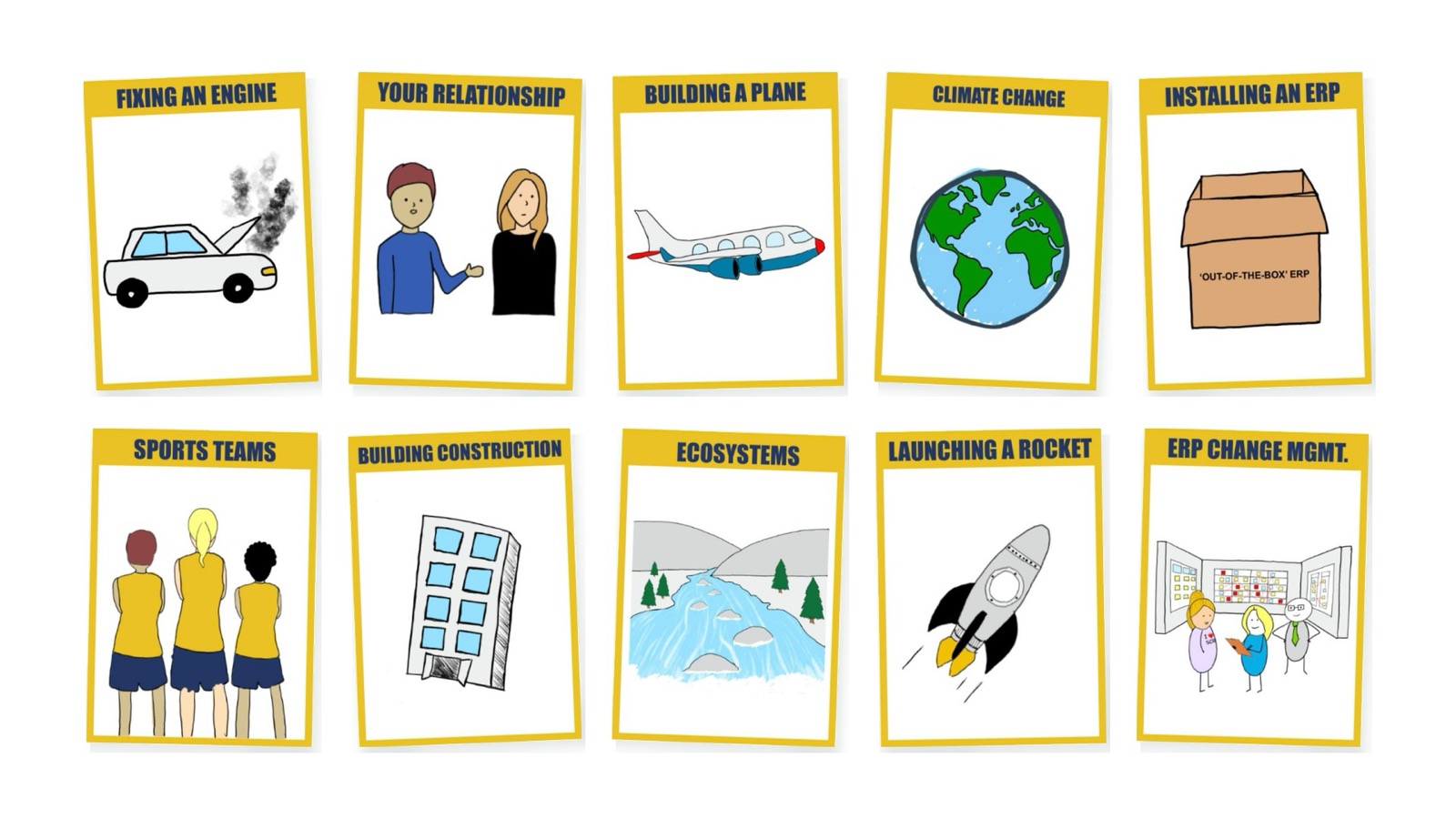
To show what I mean, I lay out a set of cards and ask people to sort them by how messy or not messy each one is.
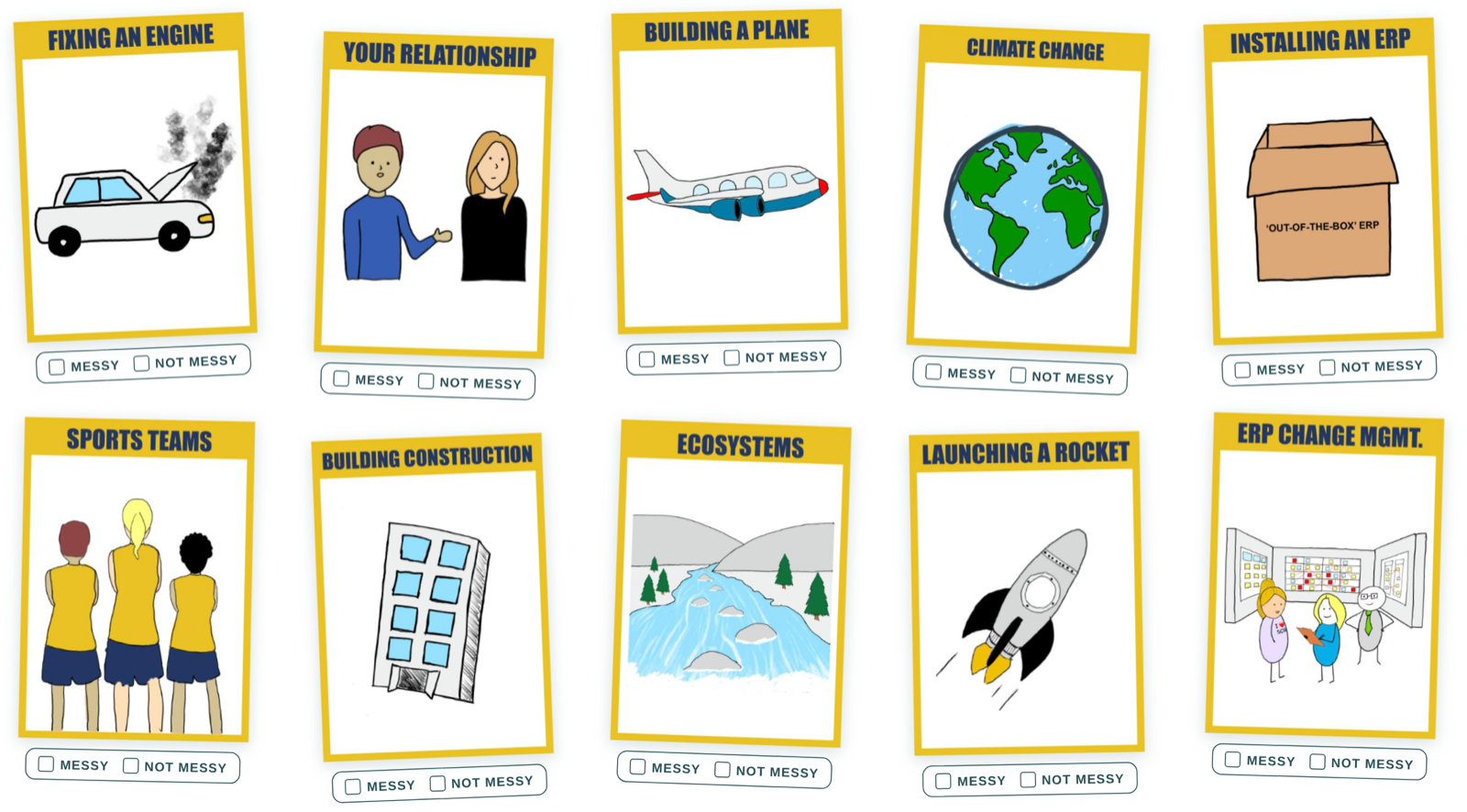
By messy, I mean how predictable the outcome is and how linear the path to solving it feels. If it's messy, you can't predict the outcome and there's no recipe to follow. If it's not messy, the outcome is predictable and there's a known way to do it.
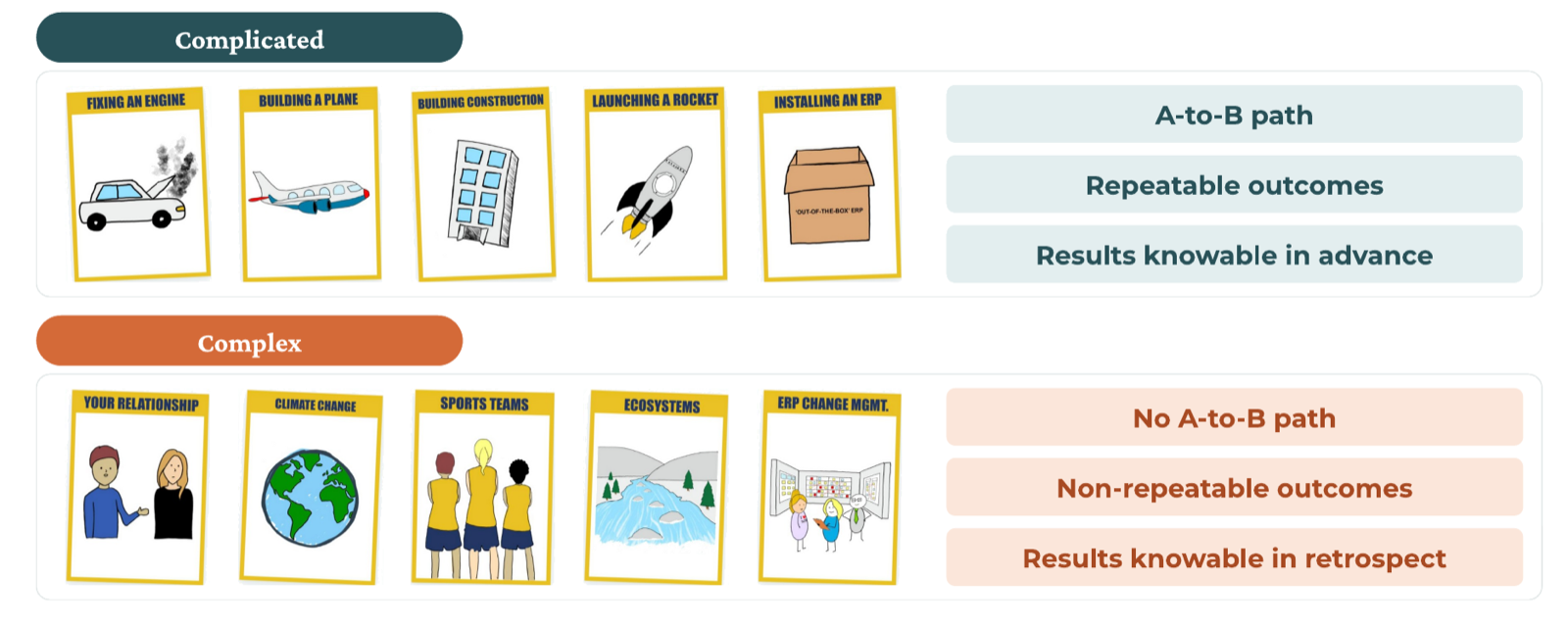
The answers are below. The cards on top are what we'd call not messy, and the ones on the bottom are messy. But the real language we should be using is complicated versus complex, and a few themes separate the two.
Complicated challenges can generally be solved by following an A-to-B path. The outcomes are repeatable. When you get on a plane, nobody had to figure out how to build it from scratch. And the results are known in advance. You know what a building will look like before it's built.
The complex challenges on the bottom are different. Every situation is unique, and there's no repeatable A-to-B path to resolving it. If there were, the same sports team would win every time. And the results are only known in retrospect. With a sports team, we only really understand why they won or lost after watching the replays. Nobody can explain in advance how the team is going to win or lose.
The big takeaway from this exercise is the two cards about project and change management. Installing an out-of-the-box ERP is largely a complicated task. It can be planned in advance with deadlines, milestones and deliverables. But getting people to embrace it, adopt it, use it and get the outcomes means working with a human system. That's a complex task, and it feels messier and less predictable.
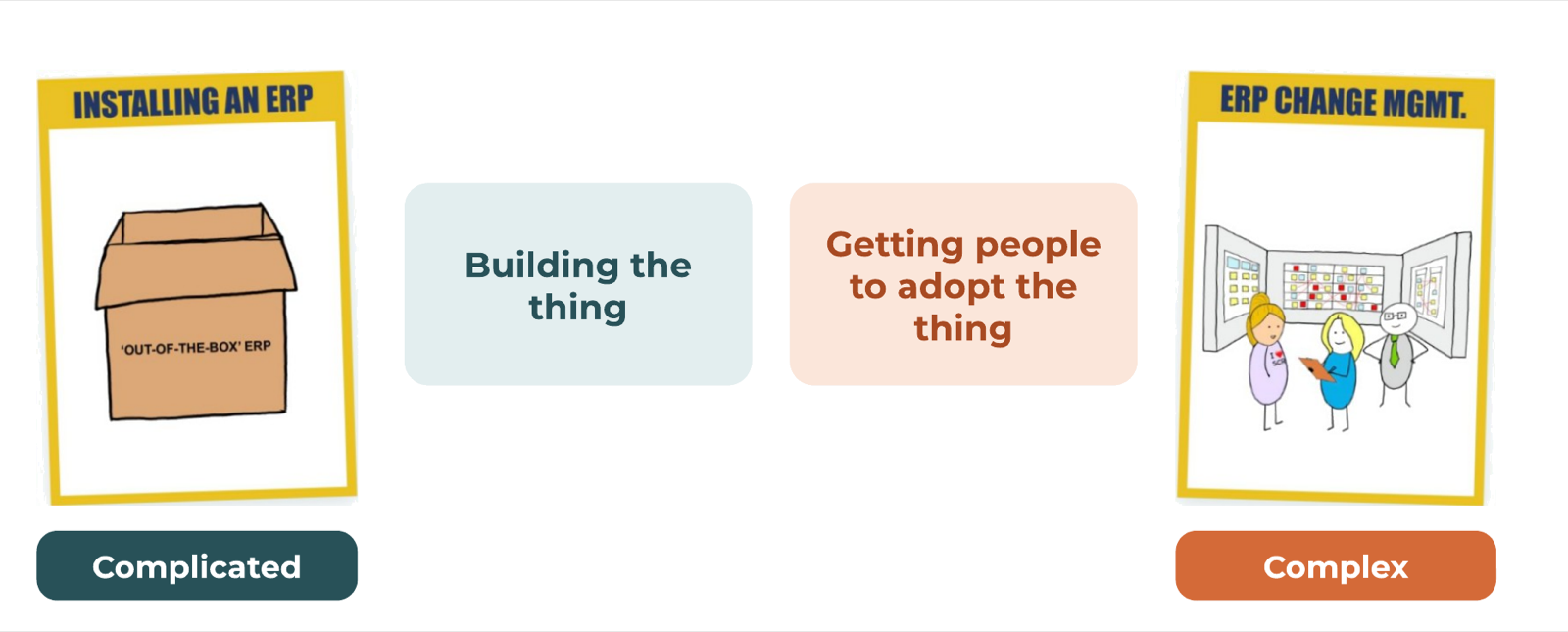
That's why no change manager would sign that contract. The implementer works on something complicated, so they can promise a repeatable result. Change managers work on something complex, so they can't.
This isn't a knock on anyone's skill. It's a description of the work. And once you see it, a lot of familiar frustrations start to make sense. The plan that looked solid in the steering committee. The rollout that worked in one region and stalled in the next. The "resistance" that turned out to be something else entirely.
Big idea 2: Organizations are complex adaptive systems
So why is organizational change complex? It's not because organizations are big or have lots of moving parts. A plane has millions of parts, but it's complicated, not complex. It's a mechanical system, and when its parts interact, cause and effect are linear.
Organizational change is complex because it happens in the context of an organization, which is made up of people with different experiences, mindsets, dispositions, worldviews, motivations, fears and hopes. Those people interact with each other and with the outside world, react to each other and adapt in response. This is why we say organizations are complex adaptive systems.
So what is a complex adaptive system? It has three basic ingredients, and a school of fish is a simple example from nature.
- Individual agents. The fish.
- Agents that interact. Each fish responds to the ones around it. They move in response to their neighbours, and they don't run into each other.
- Emergent behaviour. Behaviour you can't predict in advance by looking at the individual fish. Watch a single fish on its own and you'd never understand schooling. Emergent behaviour never repeats itself, and you can't predict the shape the school will take.
When you have these three things, you have a complex adaptive system.¹
So how does a school move as one with nobody in charge? Each fish follows a few simple rules about the fish around it. Swim close to your neighbour. Don't bump into your neighbour. Avoid predators. That's enough to produce the whole pattern, with no leader and no plan.
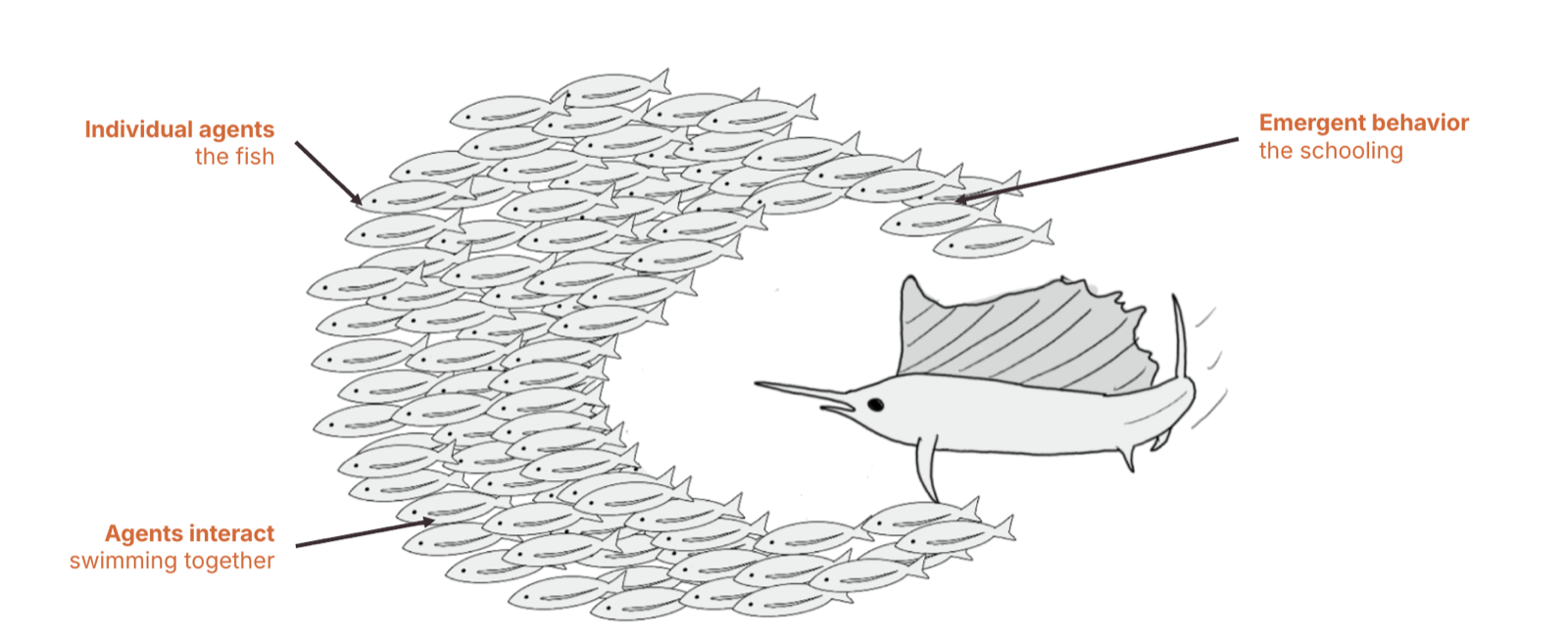
Replace the fish with the people in your organization and you can see how the analogy works, even if it's imperfect.
Big idea 3: Navigating complexity requires a shift from predict and plan to sense and respond
Every approach to leading change is built on a set of assumptions about how organizations change. Traditional change management grew up alongside project management, and it carries the same core assumption. The system is stable enough that change can be planned and executed in a straight line.
When you're dealing in known knowns, that works. There's very little deviation from the path.
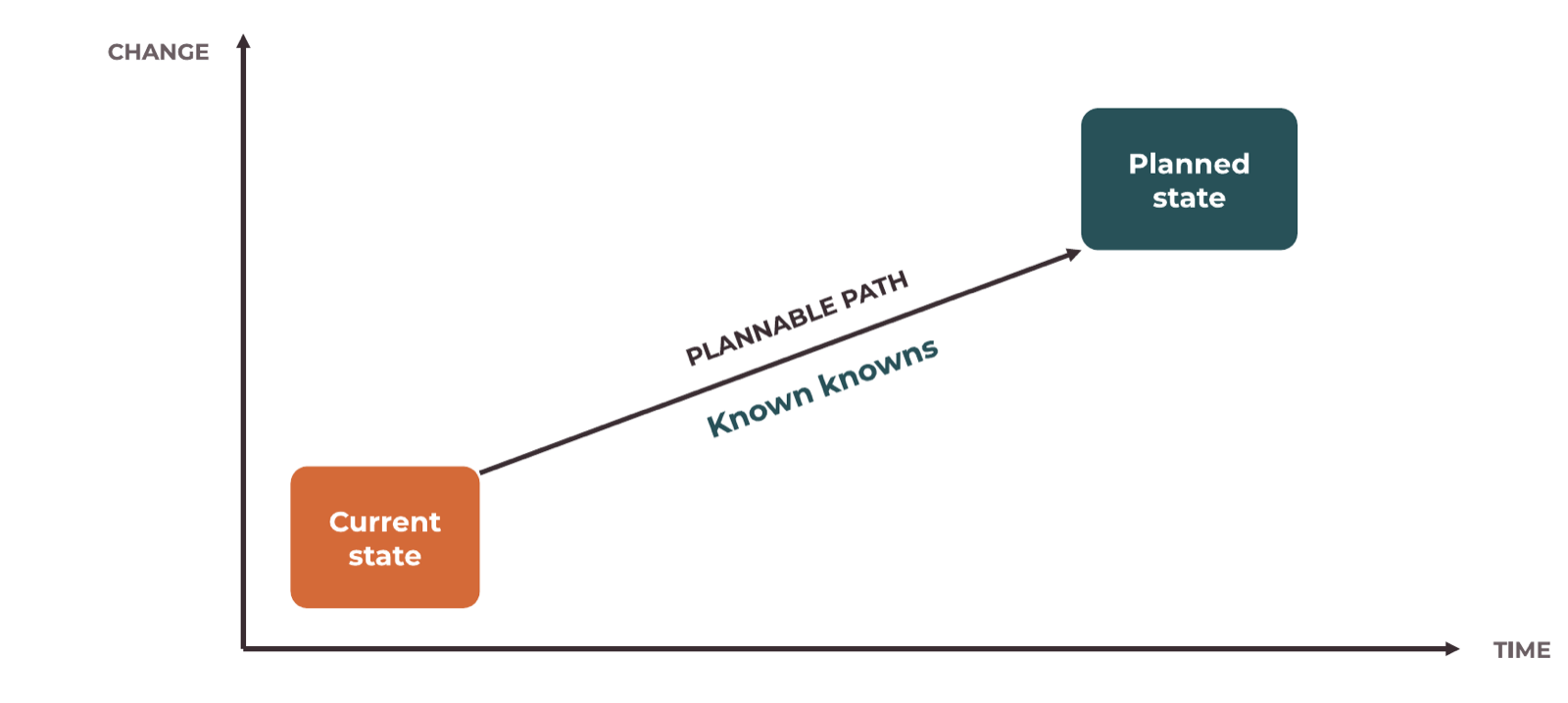
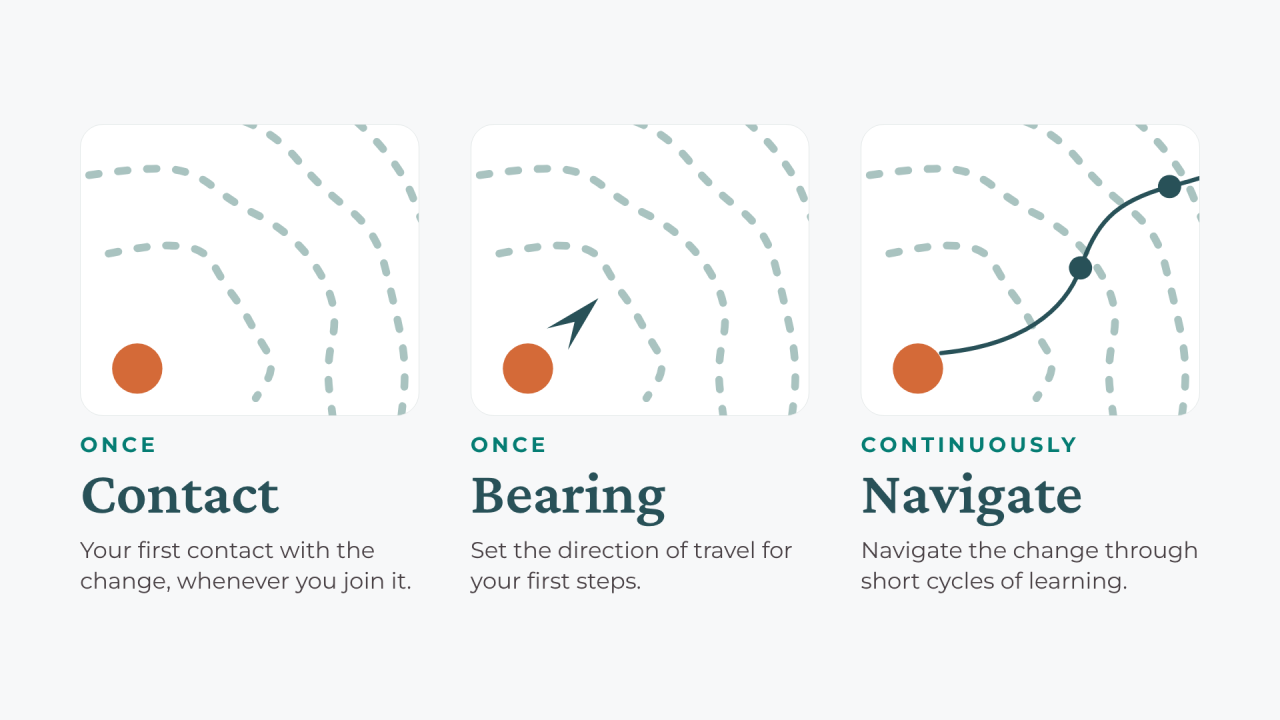
Lean Change is based on the assumption that change is complex and happens in a complex adaptive system. We have a starting point and we can set a direction, but from there we have to try something small. Through small parallel experiments, some things will work out and some won't. That's fine, because they were small. The ones that do well, we build on and keep moving. The path emerges as we travel it, and where we end up is one of several possible futures. We can't know in advance which one, or which path will get us there. This is the core idea behind the Lean Change Orientation Goals.
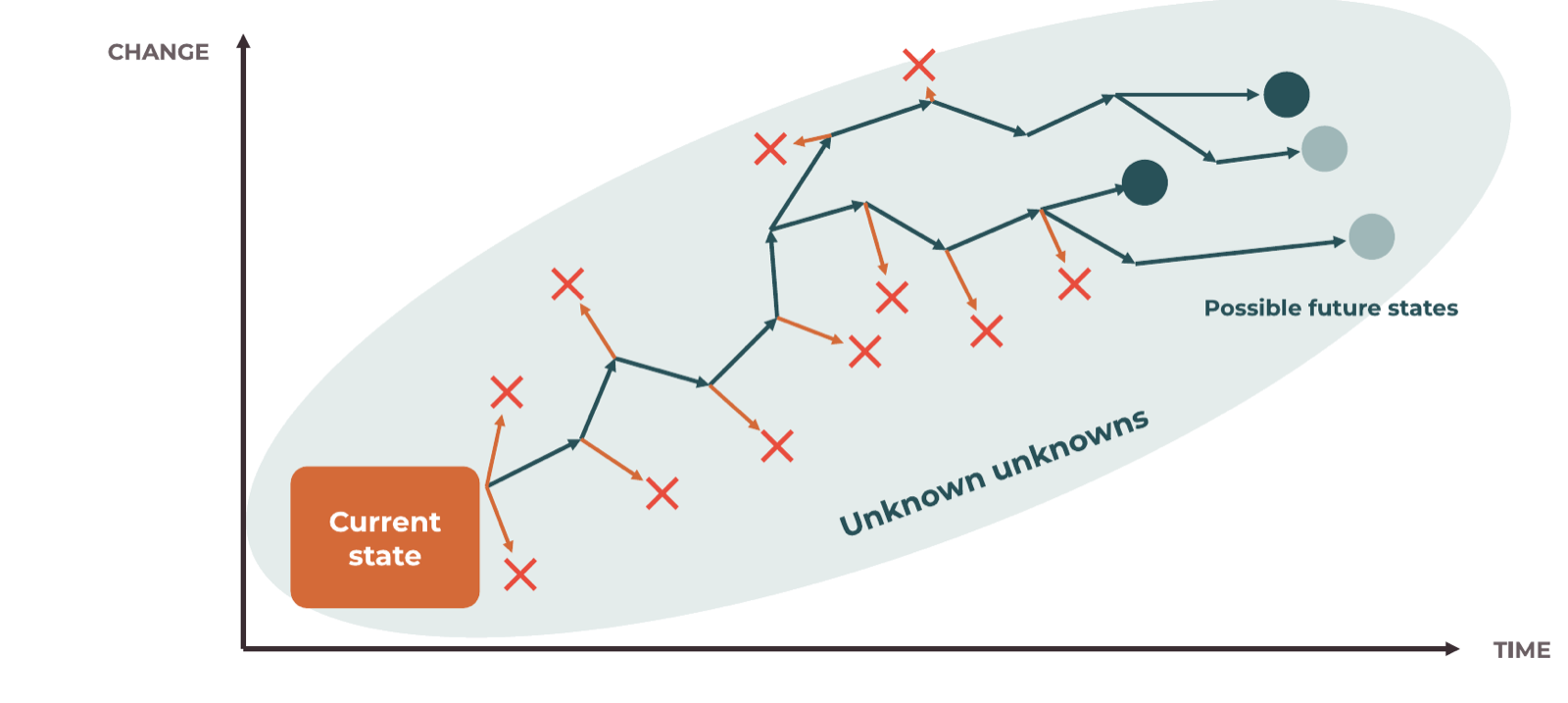
Navigate complexity with the Lean Change operating system
The Lean Change operating system is based on a complexity worldview. From this worldview, organizational change isn't deterministic, it's emergent. Rather than trying to predict or control change, Lean Change emphasizes continuously sensing, learning and adapting as conditions emerge.
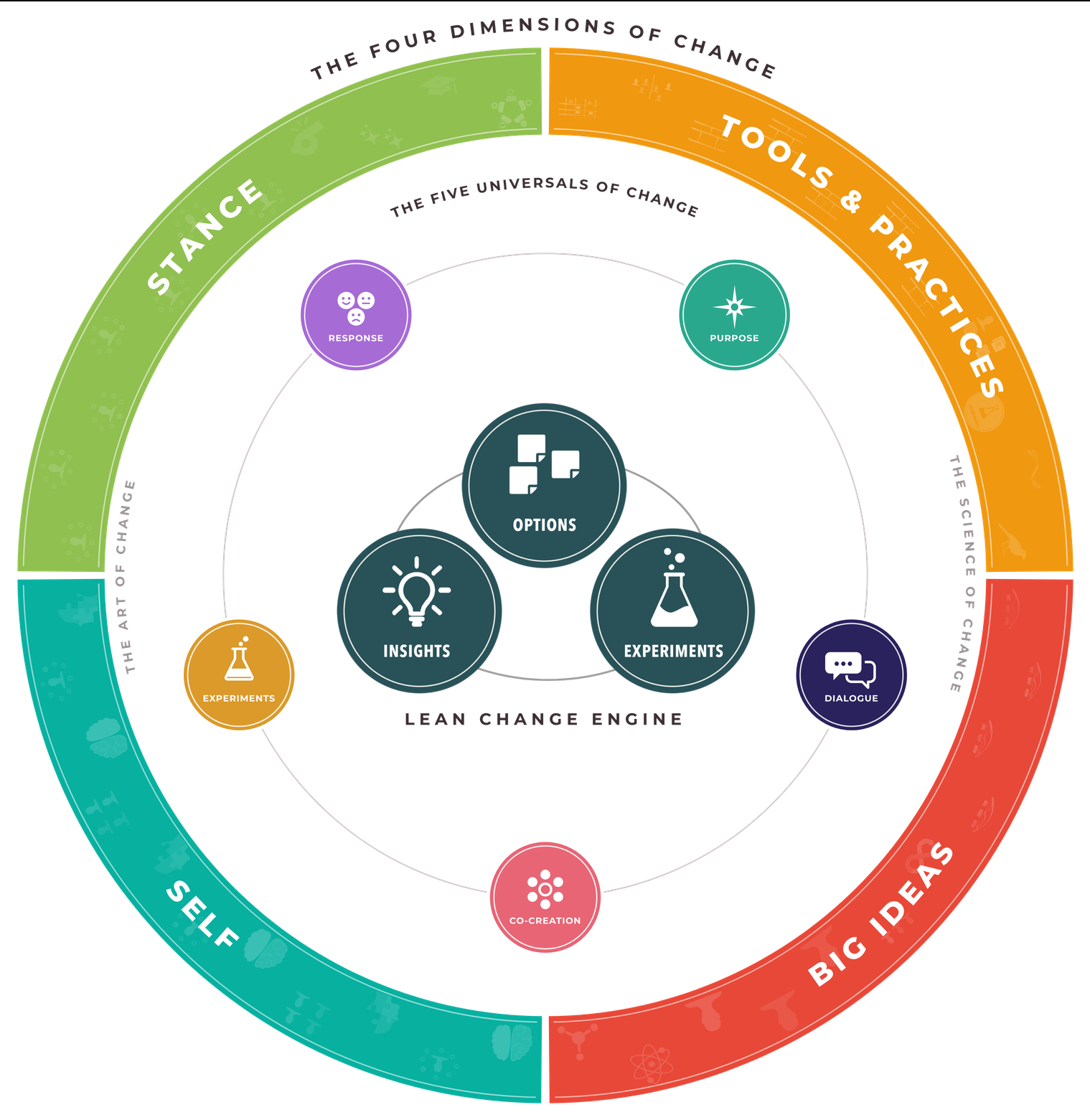
Instead of prescribing a step-by-step process, the Lean Change operating system gives you three complexity-informed constructs to help you navigate complex change.
Adaptive action: the Lean Change Engine
The Lean Change Engine transforms feedback into better interventions. As people interact with those interventions, they generate new feedback — a continuous cycle of learning and adaptation that helps practitioners navigate toward better outcomes.
Simple rules: the Five Universals of Change
The Five Universals of Change are simple rules for navigating complexity. They surround the Lean Change Engine and guide how you work with change — what you pay attention to, how you act, and how you adapt as you learn. Rather than prescribing what to do, they act as enabling constraints. They provide enough structure to guide behaviour without requiring you to analyze every possibility or follow a predetermined path. They constrain some actions while leaving many others possible.
Practitioner agility: the Four Dimensions of Change
In a complex adaptive system, we can't stand outside and manage change from a distance. We're part of the system, influencing it through how we think, show up and intervene, and being influenced by it in return. Agility is adapting to the here and now without losing sight of the why. It's less about following an adaptive methodology and more about becoming an adaptive practitioner. The Four Dimensions are your personal development, your stance, the mental models you use to understand change, and your tools and practices. Together they help you balance the art and science of change, and know when to shift your approach.
Back to the contract
So there's only one word you need to explain why you wouldn't sign the contract. Complexity.
Even with a complexity-informed approach like the Lean Change operating system, you still can't guarantee the right path forward or what the outcomes will be. I'd argue this is the biggest gap in change management thinking in business today. It's also the biggest tension we have to navigate, with leaders looking for certainty in an uncertain world.
Paradoxically, once you accept this worldview and start working from it, you may find it's the most rewarding and intellectually stimulating work you can do in organizational change management.
Justin Balaski is the principal of Lean Change and IdeaLeap. If you want to put these ideas into practice, explore the Lean Change Agent training.
References
- Snowden, D. J., & Boone, M. E. (2007). A leader's framework for decision making. Harvard Business Review, 85(11), 68–76.
1 comment
I've recently started on a project where the client wants to create an integrated work breakdown structure to thoroughly plan out tasks and activities of the PM and CM function early.
Though I understand their reasoning, I've challenged thier assumption that both follow a predictable path, stating I can provide a lean timeline, but that human nature dictates it will be a living document (likely edited daily), while leaning into a few of the points you have made in this article, though I probably could have articulated them better 😂
You can bet i'll be shamelessly stealing these analogies!