How can Lean Change help with this?
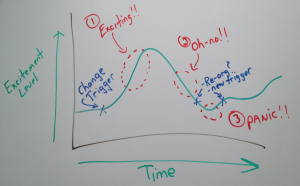
For starters, Lean Change isn't focused on being a destination like Agile Transformation often is. Lean Change is a different approach to change that relies on you understanding the dynamics of your organization so you can better choose approaches that are more likely to work. One approach is to start off with a Strategy Board. Again, Agile Transformation is a trigger for change, not a destination but there is power using Agile terminology. On the flip side, using Agile terminology might undermine your transformation if many people have a had a negative experience with Agile in a previous organization. Here's an example of how to get started using a strategy board along with some questions you can ask to create it: 1) Define long, mid and short-term goals - have progress indicators for each (IE: long term: raise employee engagement from X% to Y%. Short-term: ship Product Z on time!!) - evolve your progress indicators as you learn - how do you currently create and communicate goals in your organization? 2) Create MVC's - what needs to happen to contribute to the long, mid and short term goals? - what areas of the organization are affected? - what are the constraints for this MVC? Time? Budget? 3) Communicate Intent - have a company town hall and un-veil the Strategy Board before implementing anything - put the strategy board in an open area or on the homepage of your intranet 4) Collect Feedback to Validate (or Invalidate) Your Assumptions - use Agile retrospectives and Perspective Mapping. - use surveys (Gallup's 12 Questions, OCAI cultural assessment etc) 5) Revise Your Change Plan - update your MVC's - update your Strategy Board - involve the early adopters (the folks riding the Wave of Excitement)
Feedback-Driven over Plan-Driven
There are no shortage of change management processes. Many will cite Kotter's 8-Steps, Prosci's ADKAR or McKinsey's 7S approach to change and each of those have great ideas about how to approach change but it's silly to think applying the same change framework in any situation can work. Here's an example. Kotters first step is "establish urgency". But how do you do that? You do that through collecting Insights via Lean Change to help you understand what the problems in your organization are in the first place. Collecting Insights, from different perspectives, helps you rely on feedback in your organization over having a change advisory board that is disconnected from the realities in your organization. Remember, people don't want to feel like they're being fixed. Lean Change takes the customer development aspect of Lean Startup and merges ideas from the Agile world and the traditional change management and organizational development worlds to help you figure out what is most likely to work in your organization. Change is constant, with Lean Change you'll learn how to change within your own context. If you think Agile Transformation is the key, you've got a pretty big assumption you need to validate. Lean Change will help you do that.
Start the conversation