Context
I first noticed the effects of nitrogen narcosis once we crossed 100 feet. It’s the narcotic effect scuba divers can feel when breathing air at depth. It sort of feels like you’re slightly buzzed.
Every day, every dive is different. Some dives you would feel it at 80 feet. Some dives you would barely feel it at 120 feet. But today, I was extra sensitive to it.
Maybe because the water was cold. It was the peak of winter. A light crust of ice was on the surface as we descended. Maybe it was because it was dark. The sun was low over the mountains behind us, and the sheer wall that dropped hundreds of feet down to our left was blocking the sunlight from reaching us.
And maybe it was my nerves. I was a relatively new diver. I maybe had a few dozen dives under my belt at that time, and my dive buddy and I were following a guide to a site we’d never been to before.
For whatever reason, the narcosis was making me more nervous. I thought that slightly buzzed feeling would relax me, but it was doing the opposite. I looked at my depth gauge.
120 feet.
I’d never been this deep before. 125 feet. I began to arrest my descent by adding air into my buoyancy control device.
130 feet.
The maximum safe depth limit for recreational scuba diving. Time to pump the brakes.
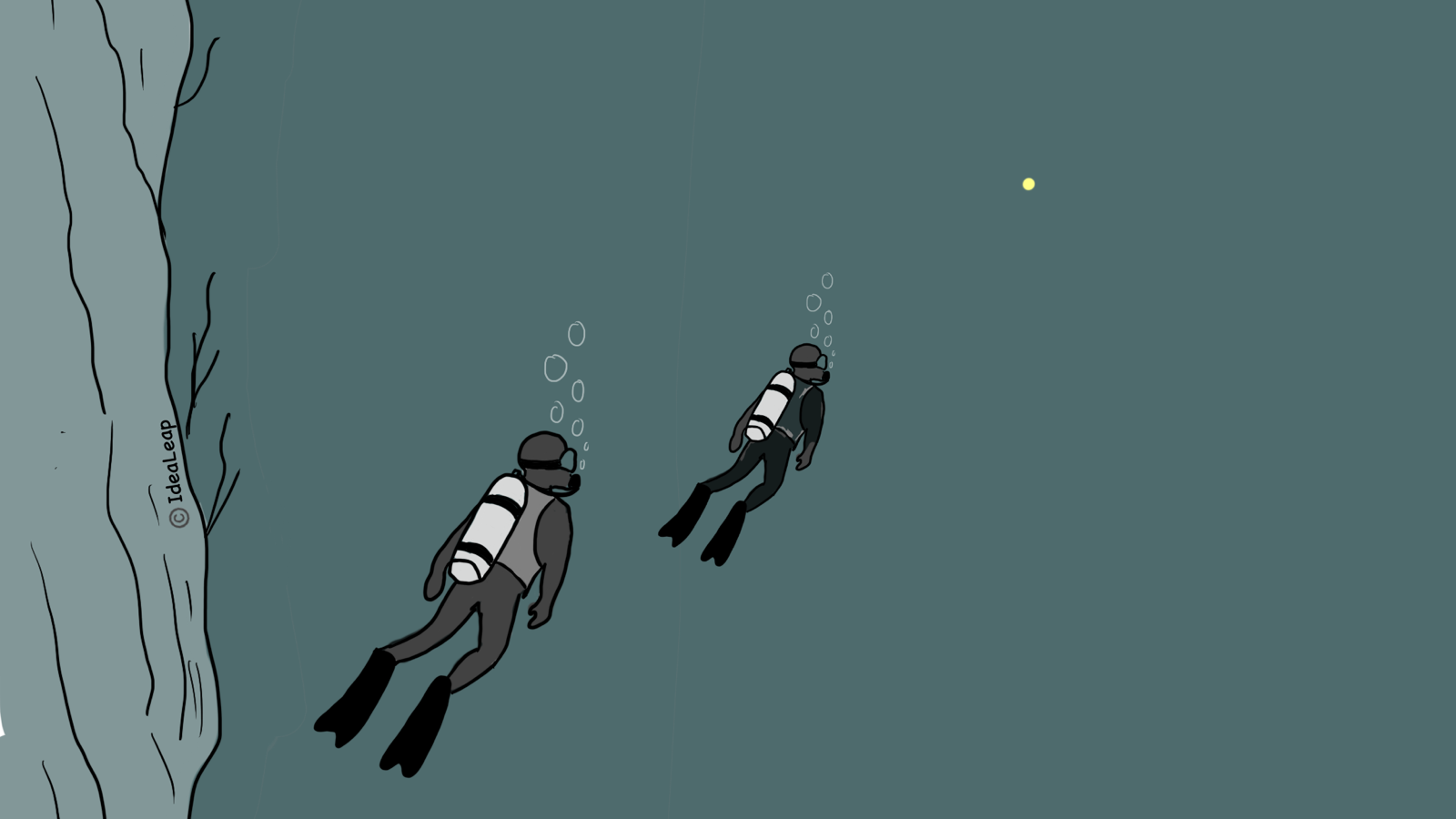
I levelled out and saw the light from my dive buddy’s flashlight behind me. We started to follow our guide, single file along the wall.
I settled in. The nerves I felt earlier seemed to disappear, and I started to enjoy the dive. Looking up, you could see the green water of British Columbia’s coast. It’s why it’s got the nickname the Emerald Sea. To our left was the wall, covered in boot sponges and octopus dens.
To our right was the abyss, where the bottom sloped away.
After about 7 minutes, it was time to start thinking about beginning our ascent up the wall.
And then things went sideways.
Our guide turned right and started heading in the opposite direction, away from the wall, over the drop-off, into the inky depths. He signalled to us to follow him.
I didn’t want to leave the safety of the wall. Out there, over the abyss, there was no reference point. Hundreds of feet of water below us, 130 feet of water above us, just floating in the nether with nothing but a depth gauge to give you one reference point of your location in a three-dimensional world.
The nerves that had been quietly in the background the whole dive came crashing back. I turned around to my buddy and looked at him, trying to yell, What is he doing? He’s going the wrong way.
We followed him out a little bit over the drop-off, and he kept going. He kept going into the abyss, getting further away. Then all we could see was a small pinprick of light from his flashlight.
And then the light disappeared.
I hit full panic mode. My eyes went wide. I started to breathe heavily, which made the panic worse, and I started to go up for the surface, out of control.
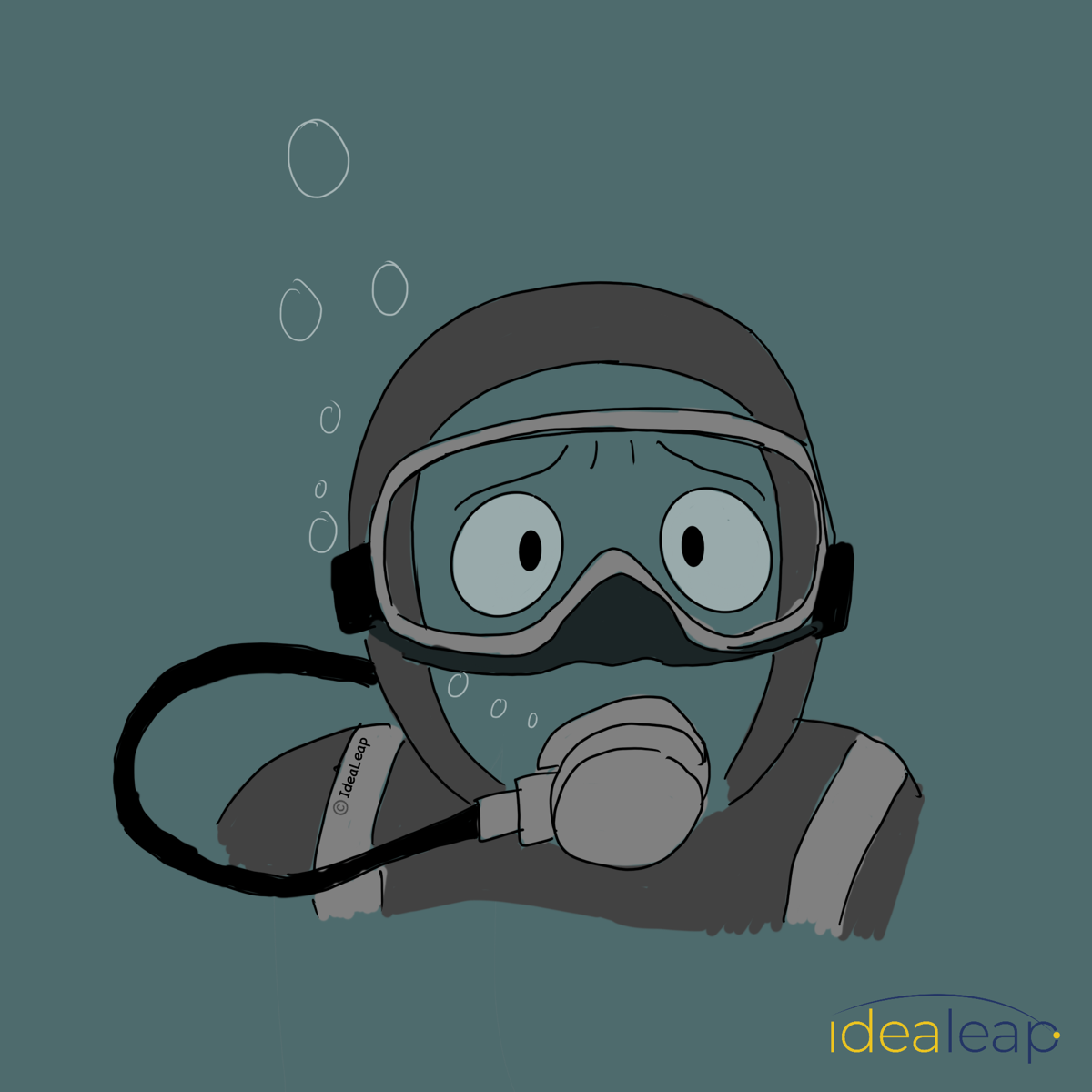
Luckily, we also started swimming towards the wall. Once I saw it, I calmed down. I was able to slow my breathing at about 60 feet and get control of myself. Then we made it to the surface.
From that day on, something changed in me. I was bit by the scuba diving bug. I went on to become an accomplished scuba diving instructor. I’m a technical diver. I dove around the world. But I never wanted to feel the way I did that day again.
After some reflection, I realized it was the fear of not knowing where I was, of being lost underwater in an alien environment, that terrified me.
I ended up talking to some salty old divers in the shop to get some advice. I bought myself a wrist-mounted dive compass. It was quite an investment for me back then. I started to practice underwater navigation, and I came up with a technique I never let go of.
Anytime we were about to start a dive, I would point the compass towards land as a reference point. Then I would turn the outer dial (the bezel) until the north needle was in the notch of the bezel. That way I knew, no matter where I was in the water, if I rotated my body until the north needle was back in the notch, I was pointed towards land.
And just with that bearing, that sense of direction, I could make sense of where I was. I could orient myself and start to follow one small landmark after another until I got back to the exit point of the dive.
A hill. A shipwreck. An octopus den. Oh, this slope looks familiar.
I made a reputation for myself as being an excellent underwater navigator. But there are no signs underwater. There are no maps in the water. All I had was one reference point.
That’s my big picture. That’s where I’m going. And the rest I had to navigate as the landscape emerged.
The Big Idea
Although I gave up my dream of being a permanent dive instructor and living abroad years ago, I somehow found my way into organizational change management. This experience, this lesson, stays with me. And it’s perhaps why I’ve always been comfortable navigating ambiguity without detailed plans, and why Lean Change has always appealed to me.
The entire Lean Change system is built around the idea that complex change can’t be predicted in advance. The path, the right change management moves to make, the issues you’re going to deal with. None of these can be known in advance. So we have to be prepared to navigate at all times.
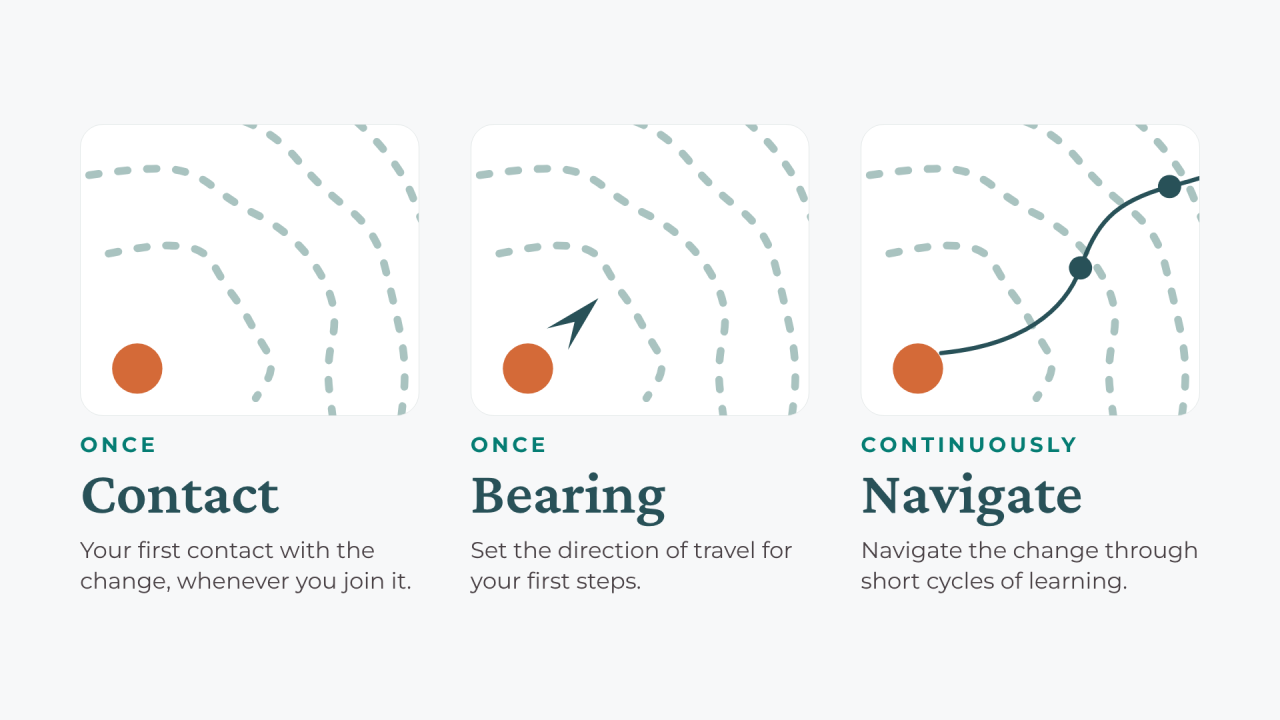
That starts with the Lean Change Orientation Goals. They help you get oriented no matter where you enter the change, because it’s rare that we enter a change at the beginning.
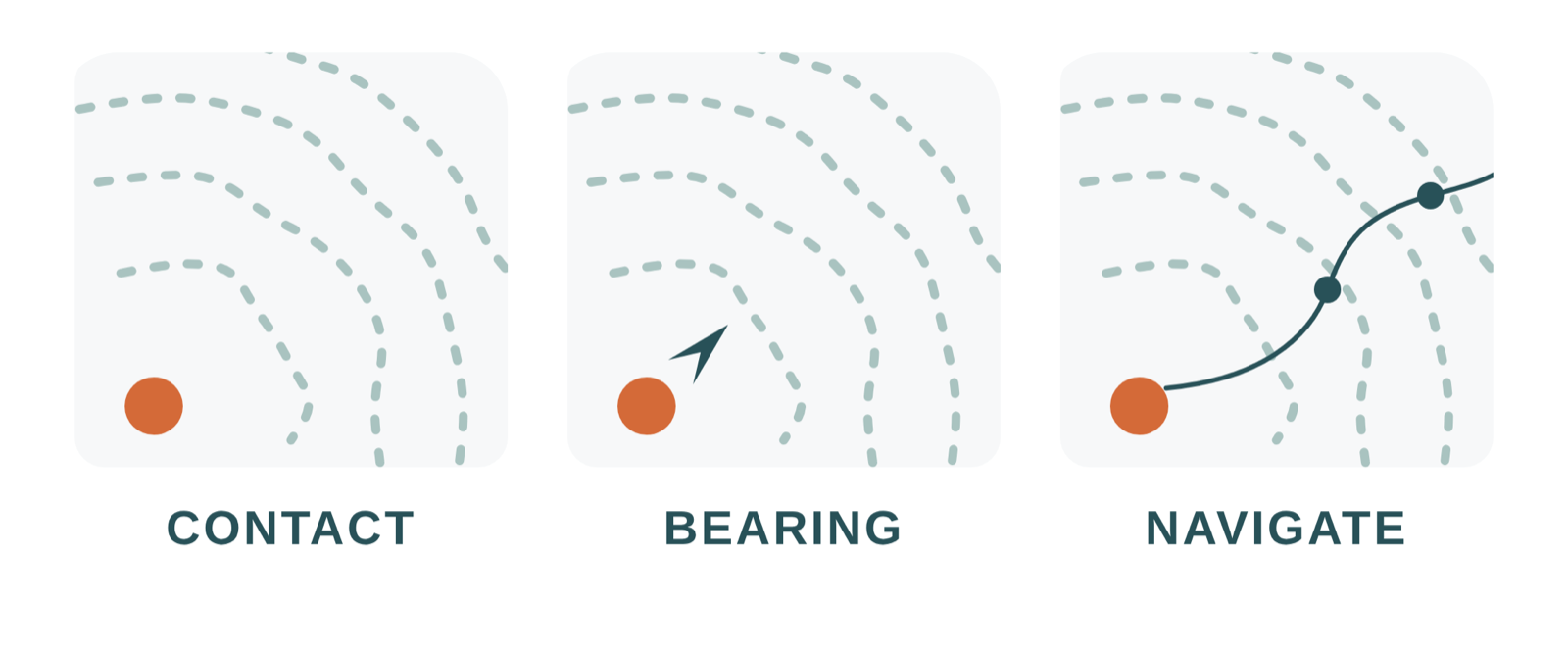
Contact
You start with the context. What are the goals? Who are the people? What’s the change? What’s been done before? Why is it happening now? This needs to happen whether you join from the very beginning, six months in, or after go-live.
Bearing
This is where you point your compass forward and lock it in. Anytime you feel disoriented, you have a reference point. What’s the big picture? Where are you headed? Knowing where you’re headed, what are the most important things to do next?
Navigate
Once you get your bearing, it’s trying something, moving in a direction, seeing how the landscape emerges before you, recognizing a good way forward, taking it, and then repeating that cycle. There’s a hill. There’s an octopus den. There’s a slope.
Lesson for Modern Change Management
When you start a dive, you align on a high-level plan. You agree on how deep you’ll go, how long you’ll stay there, and when you’ll call the dive. That sets a direction. On that dive, we had no idea the guide would turn away from the wall or that his light would disappear. We had to navigate what happened as it unfolded.
The same is true of complex change. You orient yourself to the environment, get a sense of direction, and start moving. As the landscape emerges, you decide what to do next.
We all bring our life experiences into organizational change. For me, that includes more than a decade of diving and learning to navigate an alien environment where every dive was different. That’s part of the context I bring to leading change and to what we teach in our Lean Change programs.
Know where you’re headed, and be prepared to navigate if the light disappears.
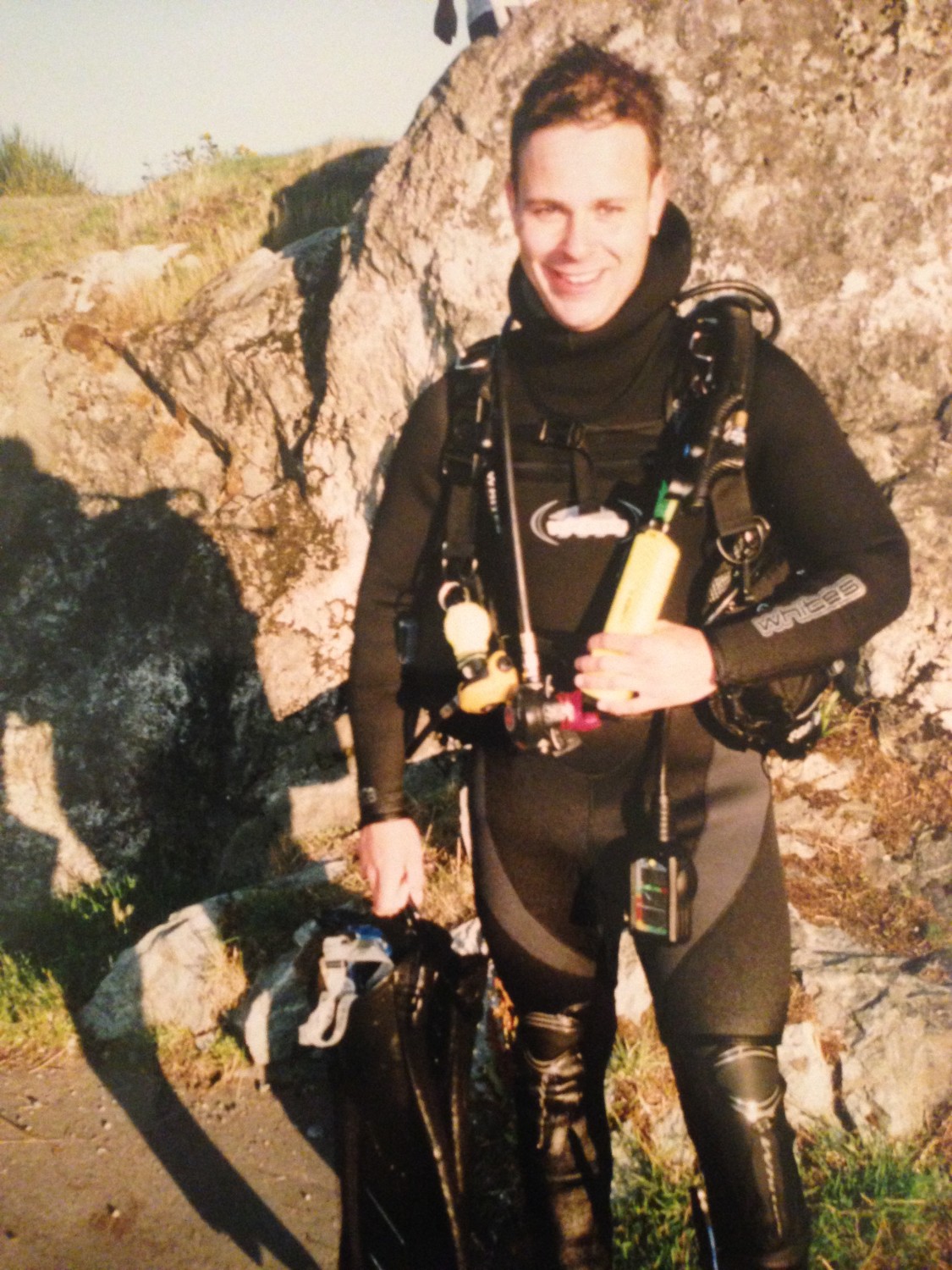
Justin Balaski is the founder of IdeaLeap and principal of Lean Change.
Start the conversation