6 Big Ideas of Adaptive Organizations
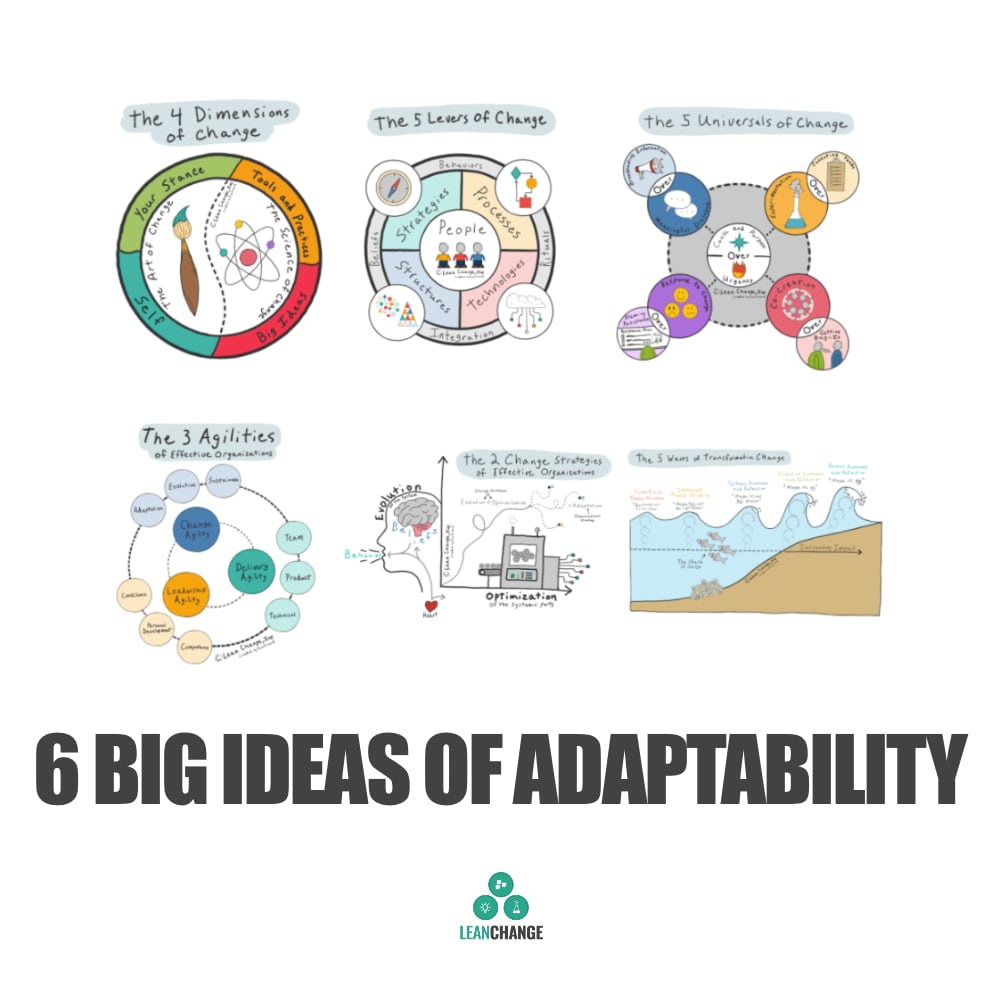
The 6 Big Ideas of Adaptable Organizations offer a comprehensive approach to managing change. They combine strategies for both incremental improvements and deep, systemic transformation, focusing on aligning people, fostering meaningful dialogue, and developing key skills. These ideas ensure that all aspects of the organization are considered, helping it adapt and thrive in a dynamic environment. By integrating personal intuition with practical tools, the 6 Big Ideas provide a robust foundation for sustainable and impactful change.
6 Big Ideas of Adaptive Organizations vs traditional thinking
Two different assumptions about how change should work.
Lean Change
The 6 Big Ideas of Adaptable Organizations help organizations navigate complex changes effectively. This modern approach balances both small improvements and deep changes, focusing on aligning people around a shared purpose and encouraging meaningful conversations. It covers essential areas like people, processes, technology, strategy, and structures, ensuring all parts of the organization are considered. Developing leadership, change, and delivery skills is key, as is understanding the different stages of change. By combining personal intuition with practical tools, these ideas enable organizations to adapt and thrive in a constantly changing environment.
Traditional Change Management
Traditional organizational change often follows a linear, predictable process that focuses on refining existing systems. This approach emphasizes creating urgency, getting buy-in, and overcoming resistance through information dissemination and task execution. It typically addresses change separately, concentrating on people, processes, and technology without integrating strategy and structures. Leadership and change skills are often ignored, leading to a focus on delivery capabilities alone. Change is seen as a series of steps rather than a complex, evolving process, resulting in superficial improvements that do not achieve deep, lasting transformation.
The 6 Big Ideas offer a comprehensive set of ideas for driving effective organizational transformation by addressing key aspects of change. First, by distinguishing between "optimization" and "evolution," organizations can improve efficiency within current frameworks while also fostering deep, systemic transformation....
Members see the deeper working notes
Sign in to read the full detailed content, relationship notes, and the richer context around how this element is applied.
Child Developments
Related child elements that expand this building block.
The 2 Change Strategies of Effective Organizations differentiate between "optimization," which improves efficiency within existing frameworks, and "evolution," which shifts beliefs and behaviors to transcend current models. Optimization focuses on enhancing parts, while evolution redefines an organization's core, aiming for transformative, sustainable change.
The 3 Agilities of Effective Organizations focus on developing three key areas: leadership agility, change agility, and delivery agility. By enhancing these capabilities, organizations can improve their ability to lead, adapt to changes, and execute effectively in a dynamic environment.
The 4 Dimensions of Change emphasize the importance of personal development, the stance one takes in driving change, the mental models used to understand change, and the practical tools and practices employed. This model balances the human aspects of change with effective methodologies to achieve impactful results.
The 5 Levers of Change provide a comprehensive approach to driving organizational transformation by addressing five key areas: people, processes, technology, strategy, and structures. By focusing on these interconnected elements, organizations can create a balanced and effective change process that enhances overall performance and adaptability.
The 5 Universals of Change focus on 5 patterns that guide effective change: aligning people around a common purpose, fostering meaningful dialogue, co-creating solutions, encouraging experimentation, and responding to change constructively. These principles help create a more inclusive and adaptive change process.
The 5 Waves of Transformational Change outline the stages an organization goes through during a transformation. These stages start with superficial changes and progress to deeper, more reflective changes. By recognizing these stages, organizations can better navigate the complexities of change and achieve sustainable transformation.
Connections to the broader Lean Change ecosystem.
Sign in to see curated resources, tools, and deeper ecosystem connections for this element.
Join / sign in →