Lean Change Element

The Relationship Wheel

The Relationship Wheel reveals the invisible dynamics—trust, power, safety, and influence—that shape how change actually moves through your system. It helps you see what doesn’t show up on the org chart.
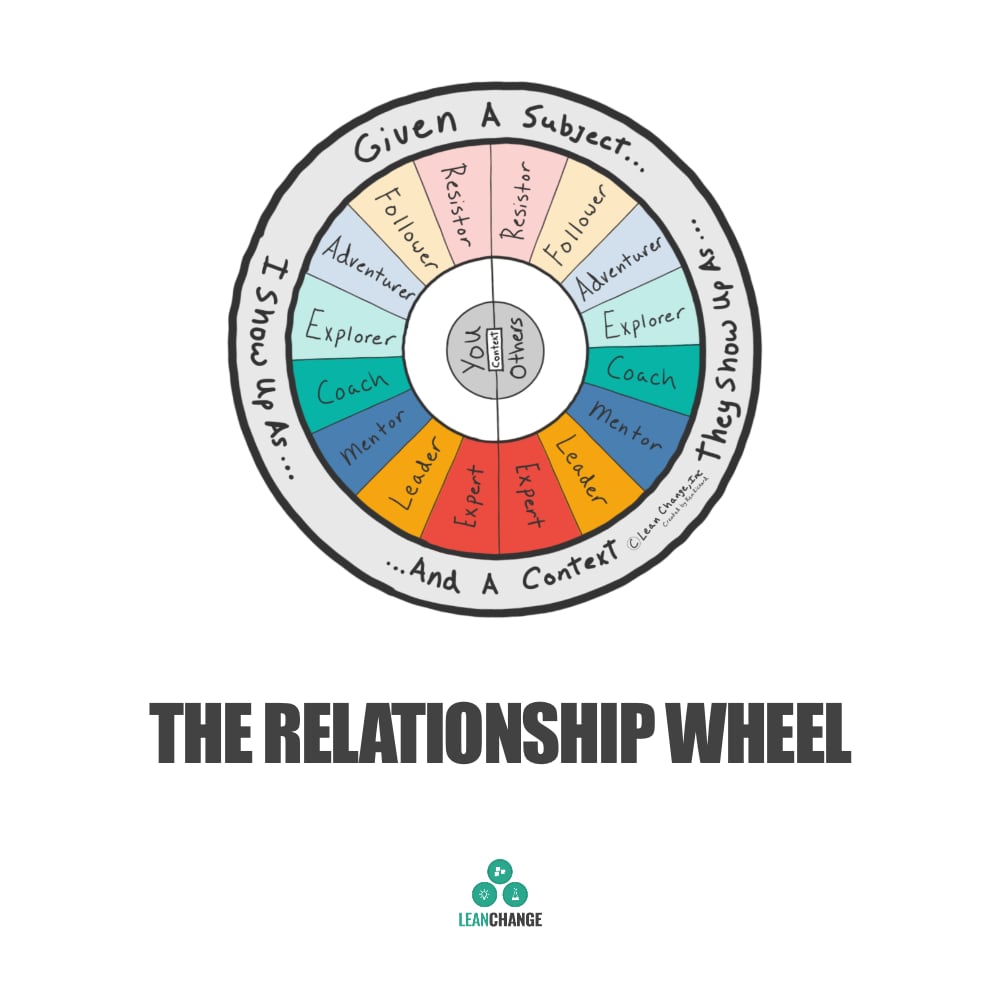
The Relationship Wheel

The Relationship Wheel vs traditional thinking

Two different assumptions about how change should work.

Lean Change

Change doesn’t flow through roles—it flows through relationships. This model helps you map the relational patterns that either amplify or block transformation.

Traditional Change Management

Relationships are rarely seen as a change lever. Influence is assumed to follow structure: job titles, reporting lines, steering committees. But what really matters—informal trust, psychological safety, unspoken alliances—is often ignored.

ArtStance

Most change plans forget one essential truth: [b]work gets done through people—and people work in relationships[/b]. The Relationship Wheel helps you explore what’s under the surface: not just who works together, but [i]how[/i] they relate to each other.The wheel is built on four relational conditions that can either support or sabotage change:[ml][ol][li indent=0 align=left][b]Trust:[/b] The currency of every system. Do people trust leadership? Each other? The process? Without trust, people won’t speak truth, take risks, or engage deeply. With it, change gets more honest and resilient.[/li][li indent=0 align=left][b]Safety:[/b] Not the declared kind—the lived kind. Do people feel safe enough to disagree, admit failure, or challenge norms? Safety is what allows experimentation and sense-making. Without it, people perform, not participate.[/li][li indent=0 align=left][b]Power:[/b] Power isn’t just positional—it’s relational. Who gets heard? Who has influence even without a title? Mapping these dynamics helps you see who holds the keys to movement—and who might be quietly resisting or protecting the system.[/li][li indent=0 align=left][b]Connection:[/b] The strength and quality of interpersonal links. Are people siloed, defensive, or aligned? Strong connection fosters shared meaning and co-creation. Weak or fractured connection leads to suspicion, turf wars, and friction.[/li][/ol][/ml]These conditions aren't abstract. They're constantly shaping how feedback travels, how conflict is handled, and whether people believe change is possible—or just another wave to wait out.The Relationship Wheel isn't a diagnostic—it’s a [b]conversation starter[/b]. Use it to ask:[ml][ul][li indent=0 align=left]Where are relationships strong?[/li][li indent=0 align=left]Where are they strained or politicized?[/li][li indent=0 align=left]What needs to shift for deeper collaboration?[/li][/ul][/ml]Once these dynamics are visible, you can decide where to invest—not just in action, but in relationship repair and rewiring.

Connections to the broader Lean Change ecosystem.

Stancethis leads toward
The Beliefs Wheel
Members only

Sign in to see curated resources, tools, and deeper ecosystem connections for this element.

Join / sign in →