The Beliefs Wheel
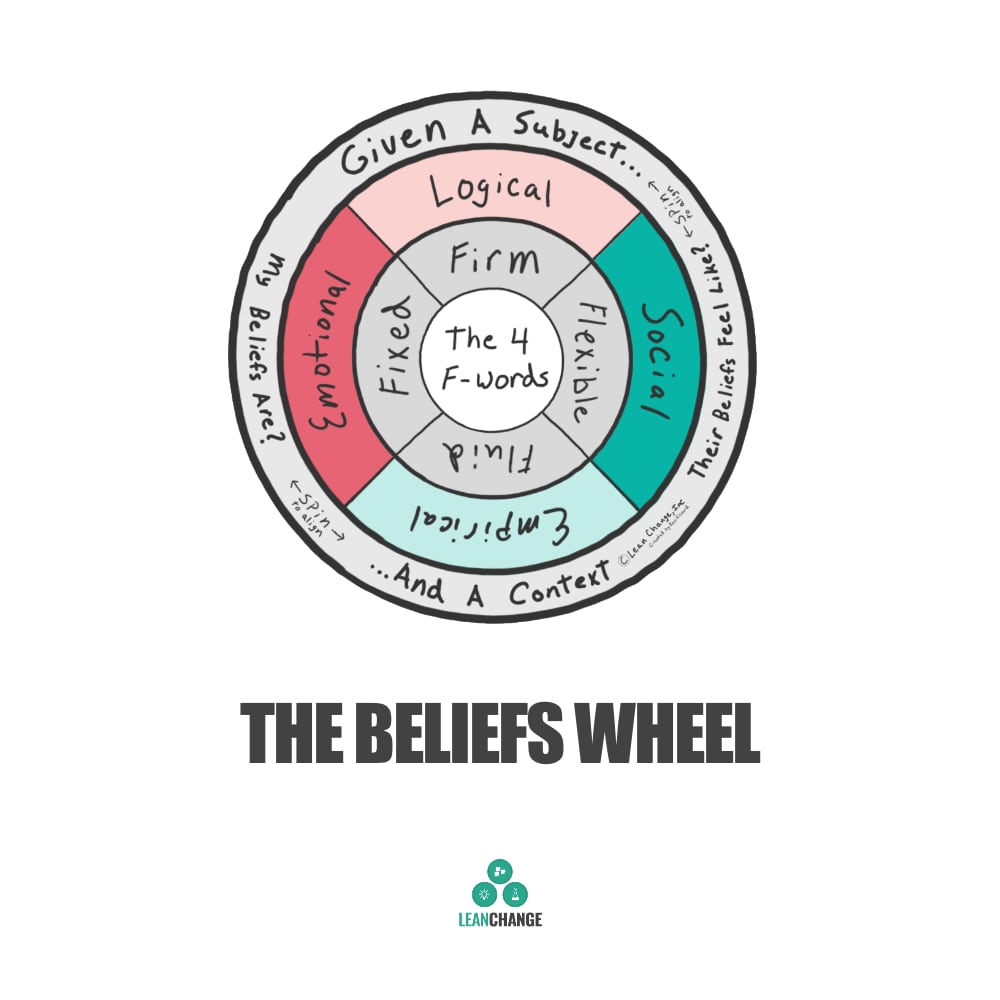
The Beliefs Wheel helps you explore what people in your system really think—beneath the official story. It reveals how shared beliefs shape action, resistance, and unintended consequences during change.
The Beliefs Wheel vs traditional thinking
Two different assumptions about how change should work.
Lean Change
Beliefs are at the core of how systems behave. If you don’t surface and explore them, your change effort will be filtered through legacy assumptions that protect the status quo.
Traditional Change Management
Beliefs are rarely addressed directly. Change is framed around process, communication, and execution—often ignoring the deeply held assumptions that shape how people actually respond.
The Beliefs Wheel is a sense-making tool that brings invisible assumptions into the light. It’s built on the insight that systems don’t behave according to plans—they behave according to the [b]shared beliefs[/b] held by the people inside them.Beliefs live in the background. They're rarely written down, but they drive how people interpret change, what they trust, and what they resist. You can roll out a new strategy, tool, or role—but if it threatens deeply held beliefs, the system will defend itself.The Beliefs Wheel maps four interrelated themes:[ml][ol][li indent=0 align=left][b]What We Believe About Change:[/b] Do people see change as opportunity or threat? As something we co-create or something done to us? These beliefs shape the system’s capacity for adaptation.[/li][li indent=0 align=left][b]What We Believe About Leadership: [/b] Who gets to make decisions? Who is allowed to challenge the status quo? Beliefs about authority, control, and voice are often the most charged—and the most invisible.[/li][li indent=0 align=left][b]What We Believe About Ourselves: [/b] Do people feel competent, valued, capable of learning? Or do they believe they’re pawns in someone else’s game? These internalized stories influence confidence and participation.[/li][li indent=0 align=left][b]What We Believe About Others:[/b] Do we trust our peers? Do we assume good intent? These beliefs shape collaboration, blame, and how power is negotiated informally.[/li][/ol][/ml]By surfacing and exploring these beliefs—without judgment—you begin to see the [b]real rules[/b] governing your system. Sometimes, you’ll find misalignment. Other times, you’ll uncover painful truths that help explain why change isn’t landing.This model isn’t about replacing beliefs—it’s about [b]making them discussable[/b]. Once beliefs are visible, you can hold them up to the light and ask: “Are these still serving us?”
Connections to the broader Lean Change ecosystem.
Sign in to see curated resources, tools, and deeper ecosystem connections for this element.
Join / sign in →