4 Forms of Organizational Design
Organizations aren’t just org charts and job titles—they’re shaped by four interconnected forms: Beliefs, Behaviors, Relationships, and Structures. This model helps you see beyond surface-level design to the deeper patterns driving how your system really works.
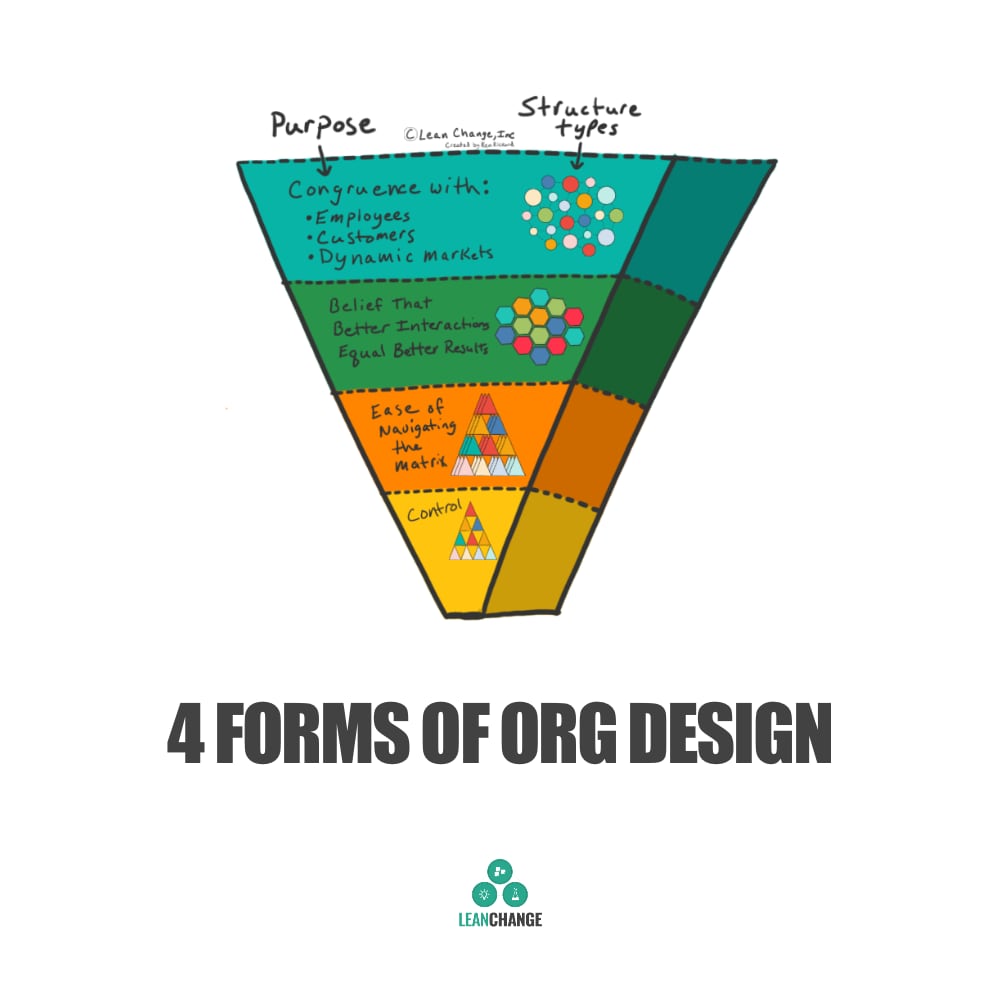
4 Forms of Organizational Design vs traditional thinking
Two different assumptions about how change should work.
Lean Change
Change is systemic, not siloed. These four forms interact constantly, and real transformation requires seeing and working across all of them—not just tweaking org charts or rolling out new tools.
Traditional Change Management
Organizational design is typically treated as a structural challenge: reorganize the hierarchy, redefine roles, or install new processes. Little attention is paid to the beliefs and relational dynamics that hold the current system in place.
The Four Forms of Organizational Design model offers a more holistic lens on how your organization is actually built and sustained. Most change efforts focus on surface-level structure—who reports to whom, what roles exist, what tools are used. But underneath that structure lies a network of beliefs, behaviors, and relationships that actually determine how work gets done.
[ml][ol][li indent=0 align=left][b]Beliefs[/b]: These are the unspoken rules, shared assumptions, and mental models that shape what people believe is “normal” or “acceptable.” You can’t see beliefs directly—but you can feel them. They show up in phrases like “that’ll never work here” or “we’ve always done it this way.”[/li][li indent=0 align=left][b]Behaviors[/b]: Behaviors are the visible expressions of beliefs. They show how people respond under pressure, how decisions are made, and how power flows. If a new process is introduced but people keep doing things the old way, it’s because the underlying beliefs haven’t shifted.[/li][li indent=0 align=left][b]Relationships[/b]: These are the informal networks and social dynamics that determine how influence and information really move. Trust, safety, hierarchy, politics—this is where all of that lives. You can change the org chart, but if the same people are still holding the same invisible power, not much will change.[/li][li indent=0 align=left][b]Structures[/b]: The formal stuff: policies, roles, workflows, and governance. Structures reflect what the organization values. They're often the last thing to change, and they tend to reinforce existing beliefs and behaviors unless intentionally designed otherwise.[/li][/ol][/ml] What makes this model powerful is the [b]interdependence[/b] of its parts. Change in one form inevitably impacts the others. For example, introducing a new collaboration tool (Structure) may fail unless there’s enough psychological safety (Relationships), willingness to experiment (Beliefs), and new patterns of interaction (Behaviors).
Members see the deeper working notes
Sign in to read the full detailed content, relationship notes, and the richer context around how this element is applied.
Connections to the broader Lean Change ecosystem.
No related elements have been published for this one yet.
Sign in to see curated resources, tools, and deeper ecosystem connections for this element.
Join / sign in →