
Lean Change Management is a feedback-driven, non-linear approach to organizational change inspired by Lean Startup, Agile, and Design Thinking. Instead of rigid plans and top-down mandates, it uses the Insights-Options-Experiments cycle to help change agents develop a contextual approach through co-creation, experimentation, and meaningful dialogue.
About a year ago Prosci published and article titled "Lean Change Management and ADKAR: Managing Modern Change". They periodically update it to keep it close to the top of search engine results and occasionally make it a sponsored ad.

While they obviously wrote that post for SEO optimization designed to, ahem, borrow our web traffic, enough people have seen it and sent me messages like, "OMG, did you see their article? What are you going to do about it?" I figured I'd respond. Most of this post is written in good fun, everyone in the know knows Lean Change Management is a modern, contextualized approach to change management based on real-world practice, and Prosci's core idea pre-dates the internet. Yes, their core idea was founded in 1995 and hasn't changed.
The intent of this post is to clear up the mischaracterization of Lean Change Management in their article because they are conflating "Lean" + "Change Management" with "Lean Change Management" and making a few comparisons that don't make any sense so I will:
- debunk the article because what they call and how they characterize "Lean Change Management" is 97% incorrect.
- hopefully steal back some of the traffic they stole from us.
- make it known that context matters and Lean Change and Prosci's ADKAR have evolved from two completely different mindsets and backgrounds. One is not better than the other and each have their purposes. Lean Change is much better suited for highly complex and uncertain change because it's feedback driven while Prosci's ADKAR is better suited for project-based change that needs to be planned up front. It is linear and plan-driven. Lean Change is non-linear and feedback-driven. We posted a comparison here.
First, SEO is fair game so good on them for using our ideas to get eyeballs on their content. Second, as mentioned, it is important to debunk the article because what they call "Lean Change Management" is not even close to what Lean Change Management is. Third, what they call Modern Change Management is not at all related to what Modern Change Management is based on a series of conference talks and presentations I did as early as 2019.
First, what's incorrect about their article
- Prosci is viewing Lean Change Management through their traditional change management lens.
- Prosci is conflating "Lean" and "Lean" + "Change Management". Meaning they are using the phrase "Lean" + "Change Management" and substituting Lean Six Sigma ideas which has nothing to do with Lean Change Management or to shorten it, Lean Change.
- Prosci maps "Lean Change" ideas to their linear approach. Lean Change isn't linear.
- Prosci falsely assumes 'excellent change management' is the reason why change succeeds. Everyone knows your change lives or dies by how well the people affected by the change lead and participate. Change managers do neither, they facilitate.
- Good sponsorship and comms isn't a change strategy. "I plan to re-plan" is. If you don't understand that, you'll never understand Lean Change.
What is Prosci ADKAR?
Prosci's ADKAR is a research-based, linear change management framework created by Jeff Hiatt in 1995. It's based on his research with hundreds of companies about why changes failed or succeeded. ADKAR has remained the same since 1996 when the world was a very different place. Their early views were "combating change resistance" and the core of their model is around the individual's journey through change while ignoring sense-making and systems thinking.
Now let's break down the individual parts of their Modern Change Management article.
What is Lean Change Management?
From their article:
Lean change management offers a structured approach that focuses on reducing waste and improving efficiency. When combined with the Prosci ADKAR® Model, which supports individual adoption, these methodologies enable organizations to drive change more effectively and sustainably.
Wrong.
Lean Change Management is a collection of ideas and tools inspired by lean startup, agile and design thinking that helps change agents develop a contextualized approach to change. It's origins date back to this post and it was refined in the trenches through practice, not research.
Lean Change Management Principles?
From their article:
Lean Change Management applies the core principles of Lean—minimizing waste and optimizing processes—specifically to change initiatives. This approach combines Lean methodologies, such as process efficiency and continuous improvement, with change management practices to enhance how organizations implement change.
Lean change management focuses on building awareness, engaging stakeholders, and ensuring active sponsorship while constantly seeking opportunities to improve processes.
Wrong. Again.
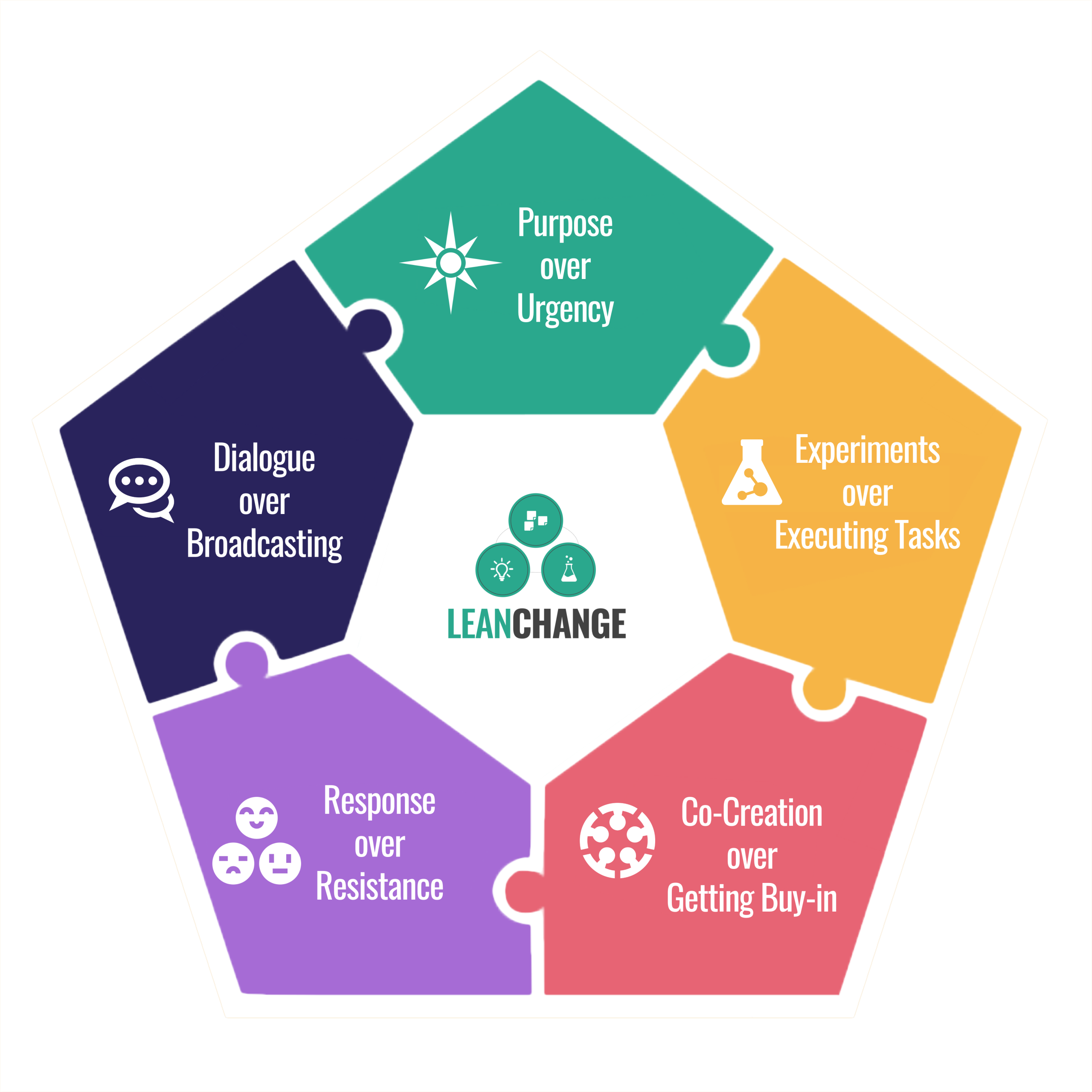
Lean Change Management does not publish principles. Principles are personal. Our view on Modern Change Management is viewed through the lenses of the 5 Universals of Change
- We value shared purpose over creating urgency
- We value co-creation over getting buy-in
- We value experimentation over "the plan"
- We value understanding the response to change over blaming resistance
- We value meaningful dialogue over broadcast-style communications
For the record, when I worked with Jeff Anderson, he was using the term Lean Startup 4 Change and the concept of MVC (Minimum Viable Changes). I disagreed with some of that because 'minimal' is in the eye of the beholder so I used experimentation. When I created Lean Change Management, the term Lean meant "as lightweight as possible" which I suppose you could say is similar to reducing waste, albeit with a different intention.
Combining ADKAR and Lean Change
I'm surprised it took Prosci more than a decade to release this post considering I wrote how to use agile practices with ADKAR back in 2014. Maybe that's the article that was, ahem, borrowing traffic from them, so they decided to write that article. Maybe that explains their lack of innovation considering ADKAR hasn't changed in three decades. It's not their fault though, they're using this formula for innovation:
Prosci Innovation = Lean Change Ideas - One Decade
Disclaimer: The pre-ceeding statement was intended for humour and does not reflect the opinion of the author, or Lean Change Inc. The author and Lean Change Inc assume no liability or responsibility in how your brain interprets said statement.
Disclaimer 2: The pre-ceeding disclaimer was intended for humour and odes not reflec the option of the author or Lean Change Inc.
From their article with the section titled "Aligning the Prosci ADKAR Model and Lean Change Management"
Integrating Lean principles with ADKAR ensures efficient and sustainable change by addressing both operational and people-focused aspects. Here’s how they align:
- Awareness – Communicate the need for change early by highlighting the benefits of Lean, addressing concerns, and showing how it adds value. This aligns with Lean’s Define Value principle.
- Desire – Build support among managers and employees to foster a desire for change. Similar to Lean’s Establish Pull, this creates momentum for change by linking it to stakeholder needs.
- Knowledge – Provide training on Lean tools and processes to ensure employees understand how to apply them. This matches Lean’s Map the Value Stream, which clarifies the key steps in change.
- Ability – Equip employees with the skills to implement Lean initiatives through hands-on support. This aligns with Create Flow, ensuring tasks are carried out effectively.
- Reinforcement – Use feedback and recognition to sustain Lean practices, mirroring Lean’s Pursue Perfection through continuous improvement and reinforcement of change.
The versatility of Lean principles in addressing diverse organizational challenges integrated with ADKAR allows organizations to embrace efficient change at every level.
Again, they are conflating Lean Six Sigma and Lean Change Management. Our view is:
- Awareness: A modern change management approach like Lean Change Management uses co-creation. Meaning, there is no 'awareness' phase or comms plan that tells people about the change and why it's important. In traditional change, by the time the change team wants to create awareness, they have already approved the plan and the budget for the change. In Lean Change Management, the change is designed with the people affected, not handed to them after it's already been decided.
- Desire: They claim this establishes pull which is incorrect because the change, budget and schedule have already been decided so the need to create desire is for optics only. In Lean Change Management, we use a concept called the Movers, Movables and Immovables and Alignment knowing that it's impossible to build intrinsic desire externally.
- Knowledge: Prosci assumes people care about how the change is going to be managed. In Lean Change Management, we show, we don't tell. As an example, while working in a Fortune 50 company, we ran a change canvas session, designed a week's worth of experiments and agreed to review them every week. When the team asked what the training would be for the "Lean Change Management" framework, we said "we just did it". And they loved it. No bloat. No presentations. In general, no one cares how the change process works. They have day jobs and want help and support.
- Ability: External change agents cannot ensure successful task execution. In Lean Change Management, the people affected by the change lead and execute. The change agents facilitate and help.
- Reinforcement: This is a tricky one. It's a statement that sounds good, after all, who wouldn't want to reinforce the change? The problem is, that makes the assumption that the change we started with is the change we'll end up with. To be blunt, shit happens. The change will evolve and in Lean Change Management we work on continual alignment, small experiments and feedback to continually refine what the change should be as well as how it gets executed.
Can Prosci ADKAR Co-Exist with Lean Change Management?
Yes and no. There's a time and place to use one, the other, or both. The important lesson in this post is that both come from two very different places and mindsets. Change management has historically been a control-based function. Meaning the change managers create the change and plan with sponsors and then execute it based on their perspective. Lean Change Management views change management as a facilitation and coaching-based function. Meaning the change managers help the sponsors and employees understand what change is needed in the first place.
Those views are vastly different.
Many change practitioner have told me Prosci's toolkit is too bloated and theoretical to be useful in practice. That doesn't mean it's not useful. There's value in selling certainty. Sometimes a nice diagram, 50+ page presentation and loads of templates and documentation makes sponsors feel safe that there is a robust enough change framework in place.
Other change practitioners have told me that's what is missing from Lean Change Management. A big, prescriptive, sequence and phase-based approach and often interpret the Lean Change Engine as "just do whatever and react to what happens."
My personal view: Your attitude, mindset and beliefs is more important than the approach for change that you use. The ADKAR model is a good model to describe the individual's journey through change because it's universal. That means if you follow the letters, anyone can understand that if you don't have awareness or desire, the change won't happen. Well duh.
The trick has never been understanding that, it's always been; "how do I interact with the system in a way that moves change forward?" To close off, think of it this way, in Lean Change Management, we view change as a rubric's cube.
In a Prosci world, that rubick's cube has coloured stickers and you can follow the script to ensure successful solving of the puzzle.
In a Lean Change Management world, that rubick's cube has tiny LED coloured panels that are shifting as you solve the puzzle and change agents need sense-making, non-linear and feedback-driven tools to recognize those patterns so they can figure out what to do next.
{ "@context": "https://schema.org", "@type": "FAQPage", "mainEntity": [ { "@type": "Question", "name": "What is Lean Change Management?", "acceptedAnswer": { "@type": "Answer", "text": "Lean Change Management is a feedback-driven, non-linear approach to organizational change inspired by Lean Startup, Agile, and Design Thinking. It uses the Insights-Options-Experiments cycle and is guided by the 5 Universals of Change: co-creation over buy-in, meaningful dialogue over broadcasting, experimentation over rigid planning, purpose over urgency, and response to change over blaming resistance." } }, { "@type": "Question", "name": "What is Prosci ADKAR?", "acceptedAnswer": { "@type": "Answer", "text": "Prosci ADKAR is a research-based, linear change management framework created by Jeff Hiatt in 1995. It describes the individual's journey through change across five stages: Awareness, Desire, Knowledge, Ability, and Reinforcement. It is plan-driven and best suited for project-based change that can be planned up front." } }, { "@type": "Question", "name": "What is the difference between Lean Change Management and Prosci ADKAR?", "acceptedAnswer": { "@type": "Answer", "text": "Lean Change Management is non-linear and feedback-driven, using co-creation and experimentation to navigate complex change. Prosci ADKAR is linear and plan-driven, designed for project-based change with upfront planning. Lean Change treats change as facilitation, while Prosci treats it as a control function. Both have their place depending on the context." } }, { "@type": "Question", "name": "Can Prosci ADKAR and Lean Change Management work together?", "acceptedAnswer": { "@type": "Answer", "text": "Yes and no. Both come from very different mindsets. Prosci views change management as a control-based function where change managers create and execute plans. Lean Change views it as a facilitation and coaching function where change managers help people understand what change is needed. They can complement each other when the context calls for it, but they are not interchangeable." } } ] }
Start the conversation