
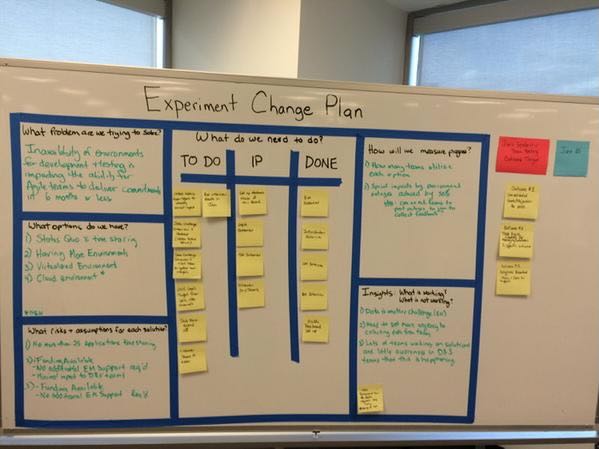
I was helping start an enterprise transformation and the main stakeholder for the transformation was sold on using Lean Change. In his view, a simple plan with weekly iterations was the easiest and less risky approach compared to using a big, bloated approach like Prosci.
Don't be offended, that was his words, but I did agree with what he said.
Change Canvases look like templates to be filled out. They're not, but despite having this conversation with that leader, he decided to fill it out on his own and present it to the other 6 executives.
While it did help us start the alignment process through dialogue, it 'felt' like there was no ownership from the rest of the executive team because they didn't help build it so they assumed he owned the transformation.
It took quite a while to show the rest of the executive team that this wasn't a one-year project that was owned by one-person. But we were starting behind simply because he presented it TO them, instead of building it WITH them.
Here's how you can avoid this problem when you decide to run a Change Canvas session for the first time.
That leader did nothing lazy. He understood the method, he believed in it, and he did the work — on his own, the night before, because he wanted to arrive prepared and respect everyone's time.
A filled-in canvas is a proposal. A blank one is an invitation. He walked into that room holding a proposal, and six executives correctly read it as his transformation. Nobody argues with a proposal. They just don't own it.
So the whole job of your first session is this: leave the room with a canvas that has the room's fingerprints on it, not yours.
Before the session
Pick one canvas. Not three.
If you don't know where to start, start with the One Page Change Plan. Terrible name, simplest artifact we've got. It asks eight questions and fits on a page. Later you can move to the Strategic Change Canvas or the Team Change Canvas, or build your own. Not now.
Important: Remember, it's the conversation, not the canvas, so the questions you'll use to facilitate the session matter more than the 'template'.
Invite everyone!
Not everyone with an opinion — everyone who will be expected to participate in it. In my story, the sponsor was in the room and the other six executives were an audience. If you can only get one of them, you don't have a session yet, you have a briefing. Wait for the calendar.
Important: I always like to invite more people at the beginning. Reason being, you give people the opportunity to participate, but they can opt-out if they don't need to be part of the process going forward.
Show up with nothing filled in.
This is the one that will feel wrong, and it's the one that matters. You have thought about this change for weeks and they haven't, so every instinct says be helpful, bring a draft. Don't. The moment there's a draft, you're presenting and they're reviewing, and reviewing is not owning. They'll nod at your boxes. Nodding is not alignment.
Bring the blank canvas and the questions. That's it.
Important: Similar to the first point, you are not the one filling it out. You are enabling meaningful dialogue. The Canvas simply holds the output of the conversation.
When your sponsor offers to pre-fill it
They will. It's the most well-meaning way this goes wrong, and it's how it went wrong for me — the person most sold on the method is usually the person most eager to do the homework.
Say yes to the thinking and no to the artifact. Ask them to come with their answers in their head, as one voice in the room rather than the version everyone else is reacting to. If they've already filled it out, don't put it on the wall. Use it as your own prep, start the session blank anyway, and let them watch their answers get challenged and changed by their peers. That's the part that creates ownership, and it's the part they'll skip if you let them.
You are not protecting the canvas. You're protecting the other six people's claim on it.
Important: Leaders usually think it 'saves time' to prep the canvas. It doesn't. It creates more problems later. That said, you WILL make this mistake, even as I implore you not to, you still will. And then your second change canvas session will go much better!
Running it: the questions, not the boxes
Canvases are placeholders for conversations. The boxes aren't the point — the questions are, and what you keep is the insight that came out of asking them in front of each other.
The One Page Change Plan asks these. Work through them in this order, out loud, together.
Why this change? Ask it and then shut up. The first answer is usually the official story. Wait for the second answer.
Why now? This is the question that surfaces the real driver, and it's the one people skip. If nobody can say why this is urgent this quarter and not next year, you've learned something important — write that down rather than inventing an answer.
How will we know we're going in the right direction? Not "how will we measure success." Direction, not destination. What will you see in six weeks that tells you this is working?
What outcomes do we want to see? What's different when this lands? For whom?
What problem do we need to solve now? The word now is load-bearing. Not the whole transformation — the next real problem.
What options do we have? Plural. Get three. If the room can only produce one option, you don't have a plan, you have a decision that was already made somewhere else, and the honest move is to say so.
The plan. Later, Next, Prepare, WIP, Review. Only fill in Next and Prepare on day one. Everything else is speculation and you'll be embarrassed by it in a month.
Insights. Leave the biggest space for this. It's the only section that will still matter in six months.
Leave things blank on purpose
You will not finish the canvas. Good.
An empty box is a finding. "We don't know why now" is more useful than a sentence someone invented so the box wouldn't look empty. Before you close the session, circle the blanks and name them out loud: these are the things we don't know yet.
That list does two jobs. It's your next two weeks of work, and it's the reason those people have to come back. A finished canvas needs nothing from anyone. An unfinished one has their name against the gaps.
When the exec wants a Gantt chart
They will. Someone will look at a canvas with three open questions on it and ask for dates, a RAG status, and a stakeholder matrix — and they'll be very focused on proof points and numbers.
Don't defend the canvas. Defending the canvas is a losing argument and it makes you sound like you're protecting a method instead of solving their problem.
Give them the thing they actually want, which is confidence that this isn't going to blow up. That sounds like: "I can give you dates for the next two weeks and I'll have evidence by then. Here's what I'm going to try, here's what I expect to see, and here's when I'll come back with what actually happened."
Then do it, and come back with the data. One completed experiment with a real result will buy you more credibility with a numbers-driven leadership team than the most beautiful plan you've ever built. This is the whole game: you're not asking them to trust the canvas, you're asking them to look at evidence you don't have yet.
After the session
Three things, that week:
- Photograph it and send it out unedited. In their handwriting, with the mess and the crossings-out. A tidied-up version you retyped is your document again.
- Do the Next column. The fastest way to kill a canvas is to hold another meeting about it.
- Bring it back and let them change it. Two weeks later, same people, same canvas, plus what you learned. The canvas that never changes is a poster. The one that gets marked up belongs to the room.
The one-line version
If they build it with you, it's theirs. If you present it to them, it's yours — and a transformation that belongs to one person is a project, not a change.
That's the whole difference between the session I ran and the one I should have run. To close off the story, eventually the main stakeholder left the organization and we had a hard time getting someone else to take ownership of it.
You can tell people that canvases are placeholders for conversations, and a living, breathing artefact until you're blue in the face but they aren't going to listen until they've felt the consequence of using a tool designed for collaboration as a typical traditional change management template.
Run your first one blank, badly, and together. That's the method.
Start here: Change Canvases · One Page Change Plan · 5 Levers of Change
Start the conversation