
"But I said we should do this change months ago!! Why don't you people listen to me?" You may have heard this while working as part of a change, or you may have thought it yourself. I used to get frustrated when I *knew* a change was the right one to do but no one else did until someone else brought up the same idea...months later. Sometimes I still do, but I think since I'm older now I expect this to happen, so I don't worry about it as much as I used to. Sometimes it simply isn't the right time for a change. If you're deeply attached to feeling it is the right time, you might feel it's wasteful to work on something else because other people don't feel it's the right thing to do. Waste is a tangible problem in manufacturing. If you're familiar with the 7 wastes of manufacturing, it's pretty easy to see the impact of waste. It's also fairly easy to measure the financial impact of waste when it comes to physical goods. So what about software? Mary and Tom Poppendieck related the 7 wastes of lean (or 7 wastes of manufacturing) to the 7 wastes of software development. Seeing the impact of those wastes are less tangible when compared to manufacturing. Take inventory for example. You can see stacks of inventory in a factory. You can't really see the impact of supporting multiple branches of code due to un-finished features. Comparatively speaking of course. You can visualize that problem with big visible information radiators or even by using big TVs showing the output of code analysis tools, but generally speaking, the impact of seeing a big pile of inventory collecting dust is a much more powerful visual that can provoke action. What about change management? Is there a concept of waste in change management? All of the work in change management is in our brains! 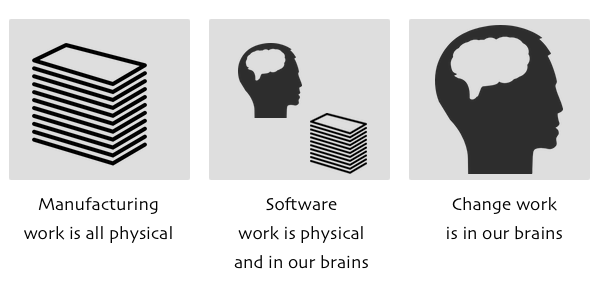
author
Start the conversation